
VistaLINX Gran Canaria guide
Maspalomas versus Playa del Inglés: Where to Stay
Maspalomas versus Playa del Inglés: compare beach access, resort layout, walks, services and evening setting before choosing your Gran Canaria base.
Published 29 September 2026
Maspalomas versus Playa del Inglés: Where to Stay
The choice between Maspalomas versus Playa del Inglés is less about picking two separate resorts than understanding two adjoining parts of Gran Canaria’s south coast with very different spatial logic. Both sit within the same broad beach and dune system, but the surroundings of your hotel, the shape of your walks and the character of your evenings can change markedly from one area to the next.
For a first visit, build a mental map before comparing hotel photographs. Maspalomas generally suits travellers drawn to a more spread out setting around the dunes, golf course areas, the lagoon and the lighthouse end of the coast. Playa del Inglés is generally more continuous and urbanised in layout, with a denser network of accommodation, streets, shopping areas and routes towards the beach. Neither label tells you everything about a hotel’s position.
Maspalomas versus Playa del Inglés: the real planning question
The useful question is not simply, “Which is better?” It is: what do you want the area around your accommodation to make easy each day?
If your priority is a holiday based around broad open surroundings, a promenade near the lighthouse and a less continuous resort streetscape, Maspalomas may be the more natural starting point. If you want everyday services close by, more choice in the immediate resort fabric and a denser, livelier setting beyond the hotel gate, Playa del Inglés may make more sense.
The boundary is not always obvious on a booking map. A property marketed under Maspalomas may be inland, facing residential roads or positioned nearer to the commercial activity of Playa del Inglés than to the lighthouse. Equally, a Playa del Inglés hotel can be close to the dunes, set back among blocks of flats or located near one of the area’s principal centres. Check the actual approach to the coast, not only the straight line marker.
Beach access is about the route, not the postcode
Both areas connect to the same broad beach and dune landscape, but access can feel different in practice. From parts of Playa del Inglés, the beach is reached through developed resort streets and along established access points. From Maspalomas, your relationship with the coast depends heavily on whether you are near the lighthouse and promenade, beside the dunes or farther inland in the wider resort area.
This matters most for travellers who expect to walk to the beach more than once a day. A hotel can appear close to sand yet sit behind roads, landscaped grounds, a large site boundary or a route that does not follow the line you assumed. Another hotel that looks farther away may have a straightforward pavement route and feel easier in daily use.
The dune reserve also changes how the coast reads. It creates a large open gap between built areas and parts of the shoreline. That is a defining visual advantage for some visitors, but it means the nearest practical beach entrance is not necessarily directly opposite your accommodation. Use a map and area view to trace the real route from hotel district to promenade or beach access.
The built environment: continuous resort or separated zones?
Playa del Inglés usually feels more connected as a resort. Development extends across a larger web of streets, and hotels, self catering complexes, restaurants, supermarkets and commercial centres are often interwoven. For travellers without a car, this can be useful: everyday errands and casual dinner options may be distributed through the surrounding area rather than concentrated in one waterfront strip.
The trade off is that the setting is less uniform. One block can be hotel focused; the next may be more commercial, residential or shaped by a main road. Choosing Playa del Inglés therefore requires a closer look at the immediate few streets around a hotel. A central position can be convenient, while a quieter feel may depend on being away from major routes and evening venues.
Maspalomas is more fragmented. The name covers several distinct settings: areas around the dunes, inland accommodation zones, golf adjacent streets and the coastal section around the Faro de Maspalomas. These places do not provide the same day to day experience, even though they share a destination name.
That separation can work well if you like returning to a hotel area that feels more self contained. It can be less convenient if you want a varied choice of shops and restaurants immediately outside. In Maspalomas, the individual hotel location often carries more weight than the headline area name.
Evening plans and what “lively” actually means
Playa del Inglés is normally the easier choice for travellers who want more activity within the resort itself after dinner. Its commercial centres and denser development create more opportunities to find bars, restaurants and entertainment without planning the evening around a promenade walk or a taxi ride. Yet this is exactly why position matters. Hotels near busy commercial zones can have a different atmosphere from those near the dunes or on quieter side streets.
Maspalomas offers more than one evening pattern. Near the lighthouse, the seafront promenade and nearby Meloneras create a clear coastal route for dining and strolling. Inland Maspalomas is often more dependent on the facilities surrounding your specific accommodation or on travelling to another part of the resort. It is not inherently silent or uniformly relaxed; it is simply less continuous.
For couples, this can come down to whether you want a walkable evening circuit from the door or are content to choose a destination for dinner. For families, consider whether the practical basics you expect, food shopping, casual meals and varied routes for a short walk, are near your hotel rather than somewhere else within the broad resort label.
Walking conditions and mobility considerations
Neither area should be judged as a single walking environment. Playa del Inglés has a more urban street pattern, but this can include changes in level, crossings and indirect routes towards the coast. Maspalomas includes long, open spaces and larger plots, which may make some journeys feel more spread out even where the terrain appears straightforward on a map.
Travellers with limited mobility, pushchairs or a preference for simple walks should inspect the exact route between the hotel entrance, local services and the beach. Look for where pavements run, whether roads need crossing and whether a coastal promenade is genuinely nearby. A hotel’s advertised area is a poor substitute for this check.
This is also where comparing neighbouring zones helps. Meloneras, immediately west of Maspalomas, has a distinct waterfront orientation around its promenade and lighthouse end. San Agustín, east of Playa del Inglés, presents another south coast alternative with a different relationship between accommodation, local streets and shoreline. They should not be treated as extensions of either area simply because they sit along the same coast.
Choose Maspalomas if open space and distinct resort zones matter most
Maspalomas is likely to suit you if the dune landscape, the lighthouse end of the coast or a more separated resort layout are central to your holiday. It can be a sensible choice for travellers who are happy to select accommodation with care and do not assume that every Maspalomas address has the same immediate services or beach route.
Focus your search on the hotel’s side of the dunes, its distance from the promenade in practical route terms and whether you prefer the Faro area or an inland base. Those are different decisions, despite sharing the same destination name.
Choose Playa del Inglés if everyday convenience leads
Playa del Inglés is likely to suit you if you value a denser choice of nearby restaurants, shops and resort activity, and prefer to have more of your holiday infrastructure distributed around you. It is particularly worth considering when you do not plan to hire a car and want the surrounding streets to do more of the work.
The key is to decide how close you want to be to commercial activity. A central location may reduce the need to travel for meals and supplies, while a position nearer the dunes can offer a different balance between services and open coastal surroundings.
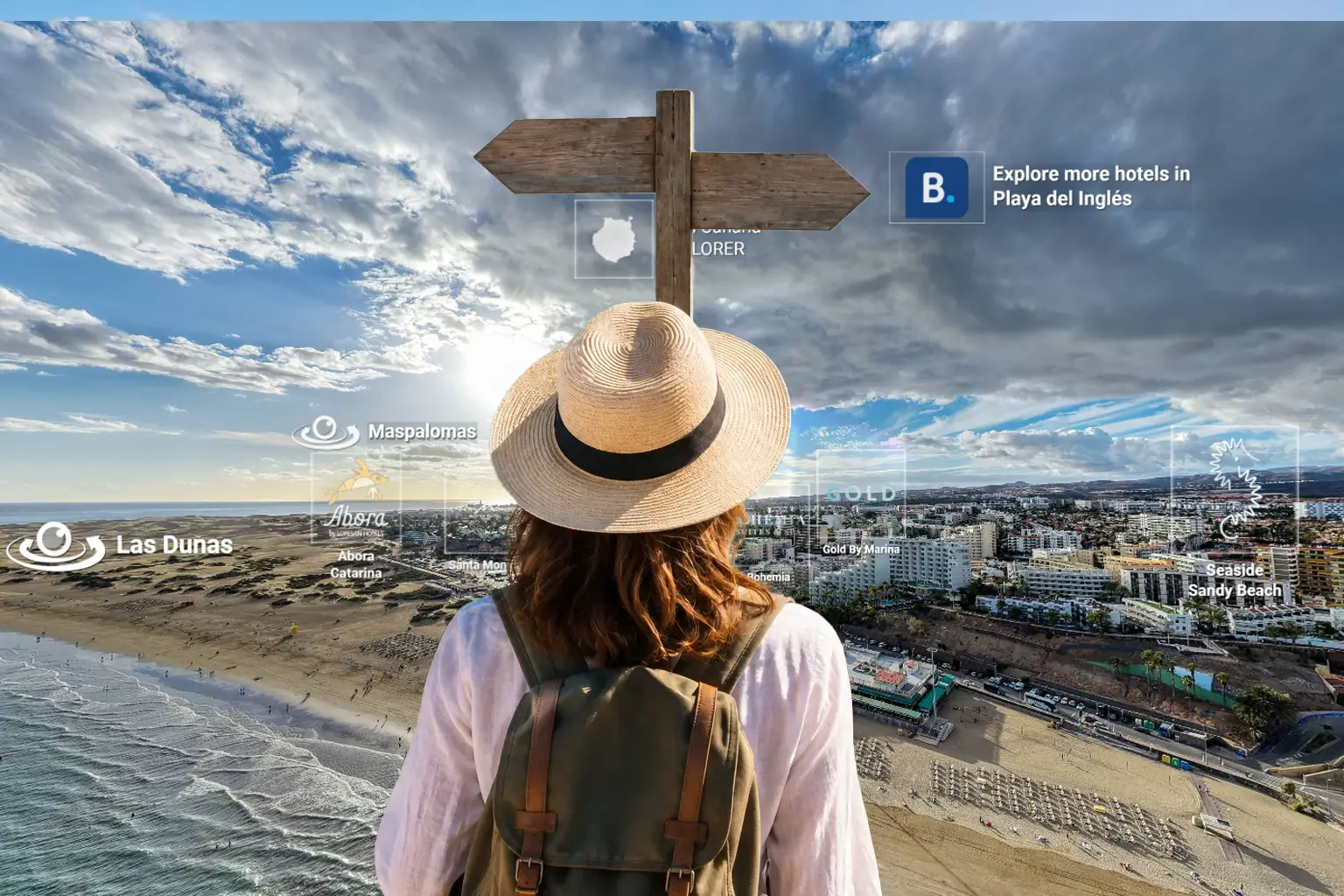
Explore the areas in 360°
Compare the coastline, dune edges, main roads and hotel zones before narrowing your shortlist. Start with Maspalomas and Playa del Inglés, then use Meloneras as a useful reference point for the lighthouse side promenade setting.
Explore Playa del Inglés in 360°
When comparing hotels, use our guide to comparing hotel surroundings before booking to assess the route to the beach, nearby services and the character of the streets immediately around the property.
The practical choice is simple: select Maspalomas when you want the destination’s open spaces and distinct zones to shape the stay; select Playa del Inglés when you want a more connected resort environment around you. Then test that decision against the exact hotel pin. The map context, rather than the area name alone, is what tells you how the holiday will work from morning to evening.
See the context
Explore Gran Canaria visually
Use VistaLINX to compare resort areas, hotel zones, beaches, promenades and terrain before choosing where to stay.