
VistaLINX Gran Canaria guide
Gran Canaria Holiday Without a Car: Where to Stay
Planning a Gran Canaria holiday without a car? Compare walkability, bus access, terrain and hotel position before choosing where to stay.
Published 12 September 2026
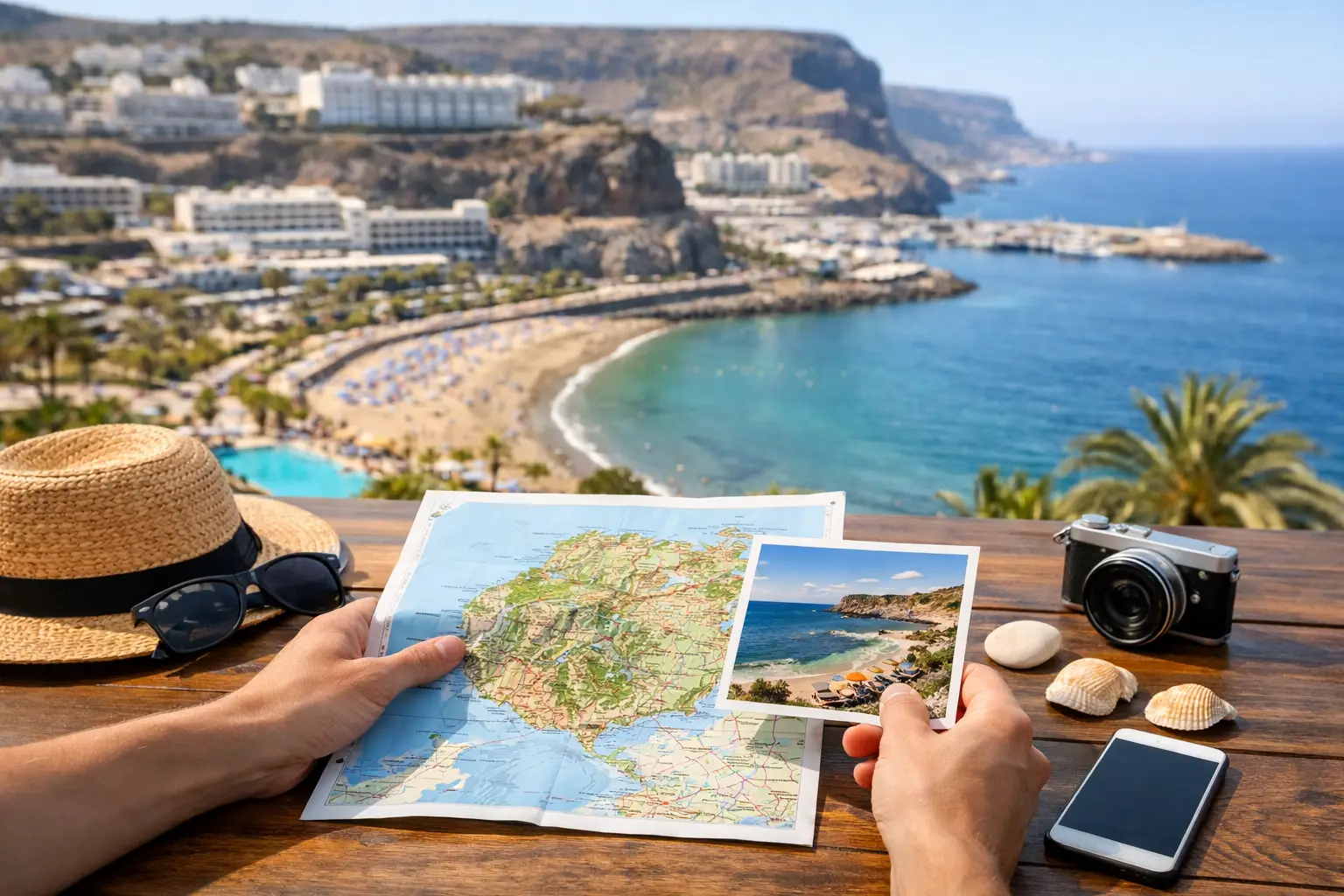
A Gran Canaria holiday without a car can work extremely well, but only when your accommodation is positioned for the life you actually plan to lead.
A hotel may be in a well connected resort yet sit above the seafront, behind a main road or at the far end of a large development.
Before booking, build a mental map of the area.
Where is the beach?
Where is the promenade?
Where are the supermarket, restaurants and bus stops?
And what lies between those places and the hotel entrance?
The key decision is not simply which part of Gran Canaria to choose.
It is whether you want a holiday based mainly on walking, regular bus journeys, occasional taxis, or a combination of all three.
Gran Canaria has resort areas that work very differently without a car, and the best choice depends on how often you expect to leave your immediate surroundings.
Compare Gran Canaria resort areas before choosing
What makes a car free stay work?
A car free holiday works best when the places you actually need are connected by routes you will genuinely use.
A continuous promenade can make neighbouring areas feel close in practical terms.
Conversely, a hotel that appears near the beach on a map can involve stairs, a hillside road or a longer route around a large resort complex.
Start with your daily pattern.
If you want to spend most days by one beach, eat locally and make a few wider trips, a compact resort or coastal town can be an excellent base.
If you picture changing beaches, visiting Las Palmas and exploring several parts of the island, public buses and occasional taxis can still make that possible, but the location of your hotel becomes more important.
Gran Canaria’s main visitor areas are connected by the island bus network, and several coastal routes link the southern resorts with Las Palmas and neighbouring southwest areas.
That makes a car optional for many holidays, but public transport does not remove the importance of choosing the right hotel location.
The exact position matters as much as the area name.
On the southwest coast, accommodation often spreads across slopes above the bays.
That can provide broad coastal views while making the return from the beach or restaurants less convenient than a straight line map suggests.
In flatter coastal settings, walking between hotel, promenade and services may be simpler, although resort developments can still cover large areas.
Gran Canaria without a car: choose the daily routine first
The south and southwest offer the broadest choice of established holiday areas, but they are not interchangeable.
Their layout determines whether you can rely mostly on your feet or whether taxis and buses are likely to become part of the normal routine.
Playa del Inglés: useful when you want choice nearby
Playa del Inglés works well for travellers who value a large resort with restaurants, supermarkets, shops and services spread across a broad built up area.
That variety can be useful without a car because you have many options locally.
The tradeoff is scale.
Playa del Inglés is not one compact pedestrian centre.
Accommodation can sit close to the beach, farther inland or beside different commercial zones.
Routes to the coast can also involve slopes or steps.
Do not assume that every hotel in Playa del Inglés provides the same car free experience.
Compare the hotel marker with the beach route, surrounding streets and the places you expect to use in the evening.
See how hotel position changes a Gran Canaria stay
Explore Playa del Inglés in 360°
Maspalomas: good for a slower, more local routine
Maspalomas is more spread out.
The dune landscape, lighthouse area, golf zones and inland accommodation create several different versions of the same destination.
This can work very well without a car when your preferred routine is centred on one hotel zone, the beach, dunes and nearby services.
It becomes less convenient if you choose accommodation farther inland but expect to walk repeatedly to the seafront.
A property beside the golf area creates a very different car free holiday from one near the lighthouse.
Maspalomas therefore rewards careful hotel selection.
Choose it when the setting itself is the main attraction and you do not need a dense resort centre immediately outside the hotel.
Meloneras: one of the clearest promenade based choices
Meloneras is often a strong option for travellers without a car because the seafront promenade provides a clear orientation line.
Hotels, restaurants and coastal walking are organised around a relatively understandable resort structure.
That does not mean every hotel has direct promenade access.
Some properties sit farther inland or have entrances that relate differently to roads and surrounding development.
But when the hotel position is right, Meloneras can support a simple daily pattern:
hotel → promenade → beach → restaurants → hotel
This works particularly well when your wider island trips are occasional rather than central to the holiday.
San Agustín: quieter and relatively easy to understand
San Agustín provides a calmer alternative to Playa del Inglés.
Parts of the area have a strong relationship with the coast and promenade, while local restaurants and services provide enough for a more contained stay.
It works best for travellers who do not require extensive nightlife or constant variety outside the hotel.
The exact hotel still matters.
Some properties sit close to the seafront, while others have a different relationship with roads and elevated terrain.
Compare quieter areas in Gran Canaria
Bahía Feliz: choose it when the local setting is enough
Bahía Feliz has a more contained hotel led environment.
That can be an advantage when you want a base where much of the holiday happens locally.
It is less compelling when your plan depends on walking between many different neighbourhoods, beaches and restaurant areas.
Public transport can connect the area with other southern destinations, but that does not make Bahía Feliz equivalent to staying in the centre of a larger resort.
Choose it because the immediate hotel and coastal setting suit you, not simply because other destinations appear nearby on the map.
The southwest: connected by road and buses, shaped by terrain
The southwest coast contains several resort areas relatively close to one another.
Public buses connect much of this coastal corridor, and taxis can make short local journeys easy.
But terrain remains the critical variable.
Puerto Rico, Amadores, Playa del Cura and Taurito are shaped by bays, valley sides and accommodation positioned at different elevations.
A resort can therefore be well connected regionally while a particular hotel is inconvenient on foot.
Puerto Rico: good services, but hotel level changes everything
Puerto Rico has one of the southwest coast’s more concentrated resort centres.
The beach, marina, restaurants, shops and everyday services are grouped around the lower part of the valley.
That can make Puerto Rico a strong car free base.
The problem appears when accommodation climbs the surrounding slopes.
A hotel that looks close to the beach may require a substantial uphill return.
Puerto Rico is therefore best evaluated vertically.
If walking convenience matters strongly, prioritise the lower resort.
If views and the hotel environment matter more, hillside accommodation can still work well when you are comfortable using taxis.
Amadores: simple when the beach is the main plan
Amadores centres more clearly on its beach.
That can make the daily routine straightforward when your holiday is mainly about swimming, sunbathing and staying close to the bay.
Accommodation, however, also extends onto the surrounding slopes.
Do not assume that a hotel overlooking Amadores provides simple pedestrian access to the beach.
The same principle applies as in Puerto Rico:
check the route, not just the view.
Compare Gran Canaria beach settings
Playa del Cura: compact, but not automatically easy to walk
Playa del Cura has a smaller and more contained environment than Puerto Rico.
That can suit travellers who want one main beach and a quieter local routine.
But compact does not mean flat.
Hotels and apartments can still sit above the coast or beside roads that change the walking experience.
Choose Playa del Cura when the immediate hotel and bay setting provide enough for most of the stay.
Explore Playa del Cura in 360°
Arguineguín and Patalavaca: more everyday town context
Arguineguín provides a different car free experience because it is a functioning coastal town rather than a purpose built resort contained within one bay.
Supermarkets, restaurants, harbour activity and everyday local services can be useful when you are staying longer or want more than a hotel focused environment.
Nearby Patalavaca provides a smaller coastal setting between Arguineguín and Anfi del Mar.
Both areas require the same hotel level check as elsewhere.
Coastal proximity does not guarantee flat access from every property.
Puerto de Mogán: perhaps the clearest compact southwest base
Puerto de Mogán can be particularly attractive without a car when you expect to spend substantial time locally.
The beach, harbour, pedestrian streets, restaurants and central accommodation exist within a compact environment.
That reduces the number of everyday journeys requiring transport.
Puerto de Mogán is also connected by public bus to other southwest destinations and Las Palmas.
The tradeoff is geography.
It sits toward the western end of the main resort coast, so it is less central when your holiday plan involves frequent trips to many other parts of the island.
Choose it when a compact local routine matters more than being centrally positioned for island wide exploration.
Explore Puerto de Mogán in 360°
When Las Palmas makes more sense
Las Palmas de Gran Canaria changes the decision completely.
Here, walking and public transport are part of normal city life rather than a workaround for not having a car.
Around Las Canteras, you can combine an urban beach with restaurants, shopping, neighbourhood streets and city services.
For a city based holiday, hiring a car may simply be unnecessary for much of the stay.
The tradeoff is that Las Palmas is not a southern resort holiday.
Choose it because you want city life and beach access together, not because you want to reproduce the experience of Meloneras, Maspalomas or Puerto Rico without a car.
Explore Las Palmas de Gran Canaria in 360°
How to compare hotels before you book
Once you have narrowed the choice to an area, stop comparing resorts and start comparing hotel context.
Look at what lies between the property and the coast.
Identify whether the nearest beach is actually the beach you expect to use.
Check whether restaurants, supermarkets and bus stops are on the same level as the hotel.
Then think about the journeys you will repeat:
morning beach trips
food shopping
evening meals
bus journeys
returning after dinner
The hotel that makes these ordinary journeys easiest may be a better car free choice than one with the better view.
VistaLINX is designed for this stage.
Use the connected views to see the seafront, terrain, roads, hotel zones and neighbouring areas before reducing the decision to star rating, room type or review score.
Explore the Areas in 360°
Explore Playa del Inglés in 360°
Explore Playa del Cura in 360°
Explore Puerto de Mogán in 360°
Explore Las Palmas de Gran Canaria in 360°
Can you have a Gran Canaria holiday without a car?
Yes.
The island’s main resort areas and Las Palmas are connected by public buses, while taxis can cover shorter local journeys.
The important decision is not whether Gran Canaria can be visited without a car.
It is whether your chosen hotel makes the journeys you expect to repeat easy enough without one.
Which Gran Canaria area is best without a car?
There is no single best area.
Meloneras can work well for a promenade based resort holiday.
Puerto de Mogán offers a compact harbour environment.
Puerto Rico provides a practical lower resort centre when the hotel is positioned well.
Las Palmas is strongest when city life and public transport are central.
Playa del Inglés offers more local variety but requires closer attention to the exact hotel district.
The right answer depends on how much of your holiday you want to spend locally and how often you expect to travel elsewhere.
The practical choice
If maximum local walking matters most, prioritise a hotel close to the beach, promenade and everyday services even if the wider resort is smaller.
If you want more resort choice, accept that occasional taxis may make the holiday easier.
If island exploration is central, choose a hotel with bus connections you are comfortable using rather than paying for a car that may spend much of the holiday parked.
The right car free base is the one whose everyday geography matches your plans.
Choose the area first.
Inspect the hotel surroundings second.
Then decide whether walking, buses and occasional taxis are enough for the holiday you actually want.
See the context
Explore Gran Canaria visually
Use VistaLINX to compare resort areas, hotel zones, beaches, promenades and terrain before choosing where to stay.