
VistaLINX Gran Canaria guide
How to Compare Hotel Surroundings in Gran Canaria
Learn how to compare hotel surroundings in Gran Canaria by checking beach access, terrain, roads, promenades, nearby services and exact hotel position.
Published 25 September 2026
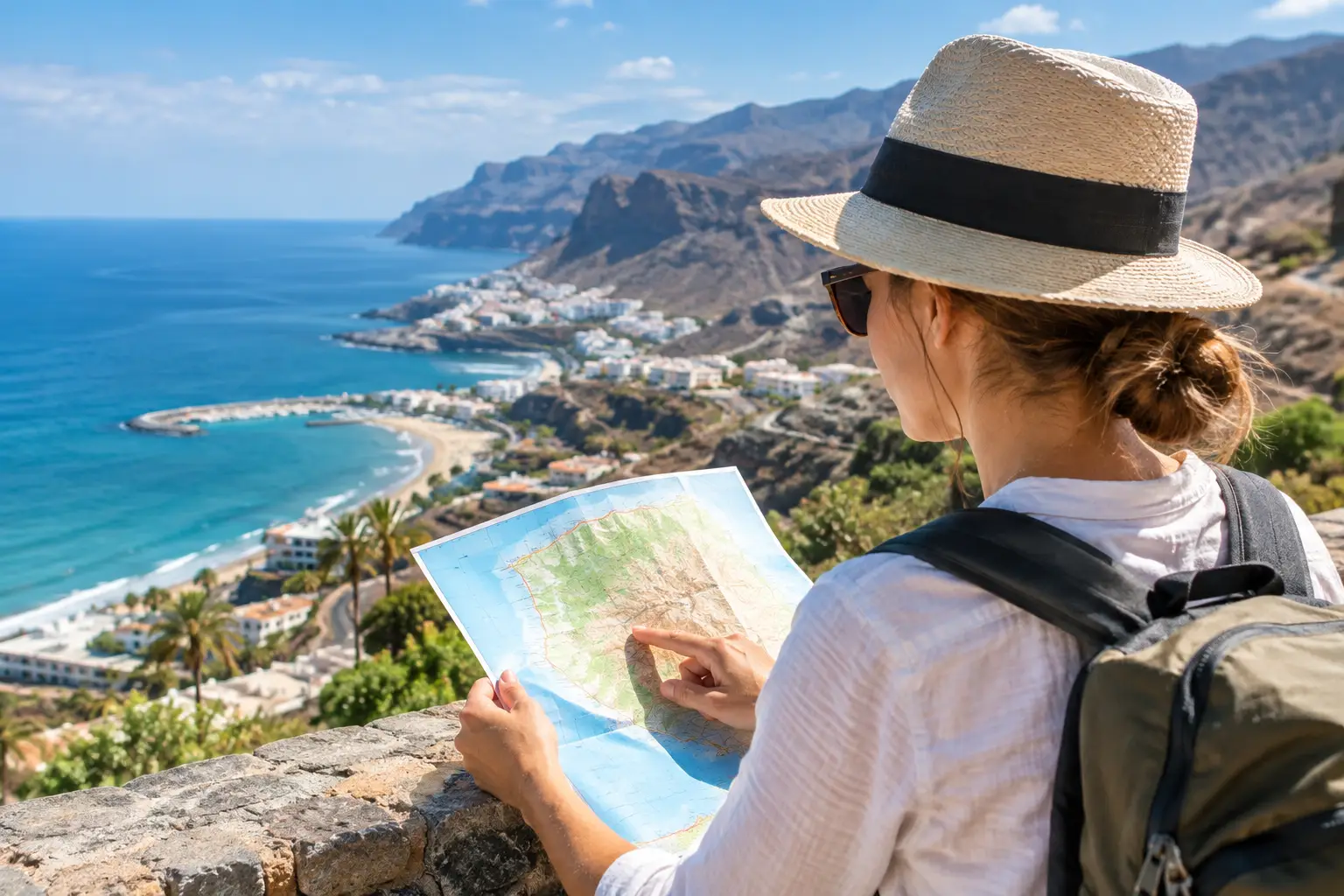
A hotel can look close to the coast on a map and still feel disconnected from the beach, promenade or evening restaurants once you arrive.
A road, a steep approach, a large resort complex or the position of the nearest useful services can completely change the practical experience.
That is why learning how to compare hotel surroundings in Gran Canaria matters before you narrow your search to individual properties.
The useful method is simple:
choose the area first
understand the surrounding geography
inspect the exact hotel position
then compare the hotel itself
That order prevents an attractive property from becoming the wrong location.
See what hotel surroundings mean in Gran Canaria
Step 1: choose the area before the hotel
An area level comparison tells you the broad structure around a hotel.
What kind of coastline is it?
Is the resort flat or built into slopes?
Is there a long promenade?
Does the area have one compact centre or several separate zones?
How does it connect with neighbouring resorts?
These questions matter because the same hotel specification can work very differently in different physical settings.
A hotel at the seafront in San Agustín creates another daily routine from one farther behind the coastal strip.
A hotel in lower Puerto Rico creates another routine from one high above the valley.
Both may be excellent hotels.
The surrounding geography changes how you use them.
Compare Gran Canaria areas before choosing
Step 2: identify the coastline you will actually use
Do not stop at the question:
“Is there a beach nearby?”
Ask:
Which beach will I actually use?
How do I reach it?
What lies behind it?
Where does the promenade go?
What happens when I leave the beach?
Gran Canaria has broad open beaches, compact bays, marina settings and urban waterfronts.
Each creates a different holiday pattern.
Playa del Inglés
Playa del Inglés has a large developed resort behind a long beach environment.
Hotels can relate differently to the coast depending on their position.
One may connect naturally with a beach approach.
Another may sit closer to commercial centres and nightlife.
Another may relate more strongly to the Maspalomas Dunes.
The broad area name does not tell you which experience you are buying.
Explore Playa del Inglés in 360°
Maspalomas
Maspalomas has a different relationship with the coast.
The dunes, golf areas, larger hotel plots and lighthouse zone shape the routes between accommodation and beach.
Two hotels can appear similarly close to the coast while creating very different walking routines.
Puerto de Mogán
Puerto de Mogán has a more compact relationship between marina, harbour streets, beach and local centre.
That can make the area easier to understand.
But accommodation farther away from the harbour core still creates a different daily pattern.
Explore Puerto de Mogán in 360°
Step 3: read the terrain
Terrain is one of the most commonly underestimated parts of hotel location.
This is especially important on the southwest coast.
Puerto Rico, Amadores, Playa del Cura and Taurito all contain accommodation at different elevations above the shoreline.
A hotel can look very close to the beach in straight line distance while requiring a much longer road or pedestrian route.
That does not make higher accommodation a poor choice.
It simply creates a tradeoff.
Higher position may mean:
better views
greater separation from the busiest waterfront
more reliance on taxis
longer returns from the beach
less spontaneous movement during the day
Lower position may mean:
easier walking
closer access to services
less elevation
more surrounding activity
Neither is automatically better.
The important thing is to know which tradeoff you are choosing.
See how walkable Puerto Rico is
Explore Playa del Cura in 360°
Step 4: find the actual hotel entrance
This is one of the easiest details to miss.
A hotel marker usually represents the property.
It does not necessarily show where you enter it.
Large resort hotels can occupy substantial plots.
The pool may sit close to the sea.
The entrance may face inland.
A resort wall, road or neighbouring development may sit between the hotel and the route you expected to use.
When comparing accommodation, try to understand:
where the entrance is
which road it faces
where the nearest pedestrian route begins
whether the beach is reached from the same side
whether taxis and buses use the same access point
This is more useful than simply measuring the centre of the hotel plot to the shoreline.
Step 5: inspect the roads
Roads affect hotel surroundings in several ways.
They can provide quick access to buses and taxis.
They can also separate a hotel from the waterfront.
A main road may define the edge of a resort.
A local road may be easy to cross.
A winding hillside road may turn a short visual distance into a much longer walk.
Look at the road system as part of the holiday environment.
Ask:
Do I cross this road every time I go to the beach?
Does the hotel entrance face the coastal side or inland side?
Does the road climb?
Does the route continue naturally to restaurants and shops?
These questions tell you more than the phrase “central location”.
Step 6: test the promenade
A promenade is useful when it connects the places you actually need.
It can link:
beaches
restaurants
cafés
shops
neighbouring areas
evening walking
busier resort zones
But not every waterfront path works the same way.
Meloneras has a strong promenade led structure.
San Agustín has useful coastal walking sections.
Playa del Inglés provides many walking options but not one simple promenade logic throughout the whole resort.
The value of the promenade depends on how your hotel connects to it.
Compare the best areas for promenade holidays
Step 7: look at the nearest useful services
A beach is only one part of the stay.
Where will you buy water?
Where will you have breakfast?
Where is the supermarket?
Where will you go for dinner?
Where is the bus stop?
What happens when you want something outside the hotel?
A hotel can be close to the sea and still feel inconvenient if everything else sits in another direction.
This becomes particularly important without a car.
See where Gran Canaria works without a car
Step 8: read the surrounding development
Do not stop at the hotel boundary.
Look at what sits immediately beside it.
Another resort hotel?
Residential buildings?
Vacant land?
A supermarket?
A commercial centre?
A roundabout?
A quiet street?
A marina?
A main road?
The immediate surroundings influence the atmosphere of the stay.
They also tell you how naturally the hotel connects with the wider area.
Bahía Feliz and Taurito can feel relatively self contained.
Arguineguín has more ordinary town life around visitor accommodation.
Patalavaca has a different relationship with the coast again.
The resort name does not capture these differences.
Step 9: picture one ordinary holiday day
This may be the most useful test of all.
Do not picture the arrival.
Do not picture the pool photograph.
Picture Tuesday.
You wake up.
Where do you walk for breakfast?
How do you reach the beach?
Where do you buy something you forgot?
What route do you take for dinner?
How do you return afterwards?
If children are with you, how often will you repeat the beach route?
If you are travelling as a couple, do you want restaurants outside the door or a quieter return?
If you are not hiring a car, what journeys become normal on foot?
Once you can picture an ordinary day, hotel surroundings become much easier to evaluate.
A simple VistaLINX comparison sequence
Use the same sequence for every hotel.
1. Area
What type of destination environment is this?
2. Coast
What beach, bay, promenade or marina will I actually use?
3. Terrain
What sits above or below the hotel?
4. Access
Where is the entrance and what road does it face?
5. Walking
What routes will I repeat every day?
6. Services
What can I reach without planning a separate journey?
7. Atmosphere
What surrounds the hotel once I leave the property?
Only after those seven questions should you compare:
rooms
pools
breakfast
board basis
facilities
reviews
That changes the hotel search from selecting an isolated property to choosing a place that works within its real surroundings.
Explore contrasting areas in 360°
Compare a large southern resort:
Explore Playa del Inglés in 360°
Compare dunes and dispersed resort geography:
Compare a promenade led resort:
Compare a steep southwest valley:
Compare a compact harbour setting:
Explore Puerto de Mogán in 360°
What should I check first around a Gran Canaria hotel?
Start with the route between the hotel and the place you expect to use most.
For many travellers that is the beach.
For others it may be the promenade, restaurants or public transport.
Then check terrain, roads and the nearest everyday services.
How can two hotels in the same resort feel so different?
Because resort names describe broad areas.
The hotel plot determines the real relationship with the beach, slopes, roads, restaurants, promenade and neighbouring development.
Two properties can therefore share the same resort name while creating very different daily routines.
Is hotel distance to the beach enough?
No.
Distance does not describe elevation, road layout, stairs, access points or the direction of the hotel entrance.
The route matters more than the measurement.
The practical choice
Choose the area first.
Understand the coast.
Read the terrain.
Find the entrance.
Trace the roads.
Check the promenade.
Locate the services.
Look at the surrounding development.
Then imagine an ordinary day.
Only after that should you compare the hotel itself.
The strongest hotel choice is rarely the property with the most impressive listing photograph.
It is the hotel whose surroundings make the holiday you want easier to live.
See that context before you decide.
See the context
Explore Gran Canaria visually
Use VistaLINX to compare resort areas, hotel zones, beaches, promenades and terrain before choosing where to stay.