
VistaLINX Gran Canaria guide
Gran Canaria Spatial Planning Guide for Holidays
Use this Gran Canaria spatial planning guide to compare coastlines, slopes, promenades and resort layouts before choosing where to stay on the island.
Published 18 November 2026
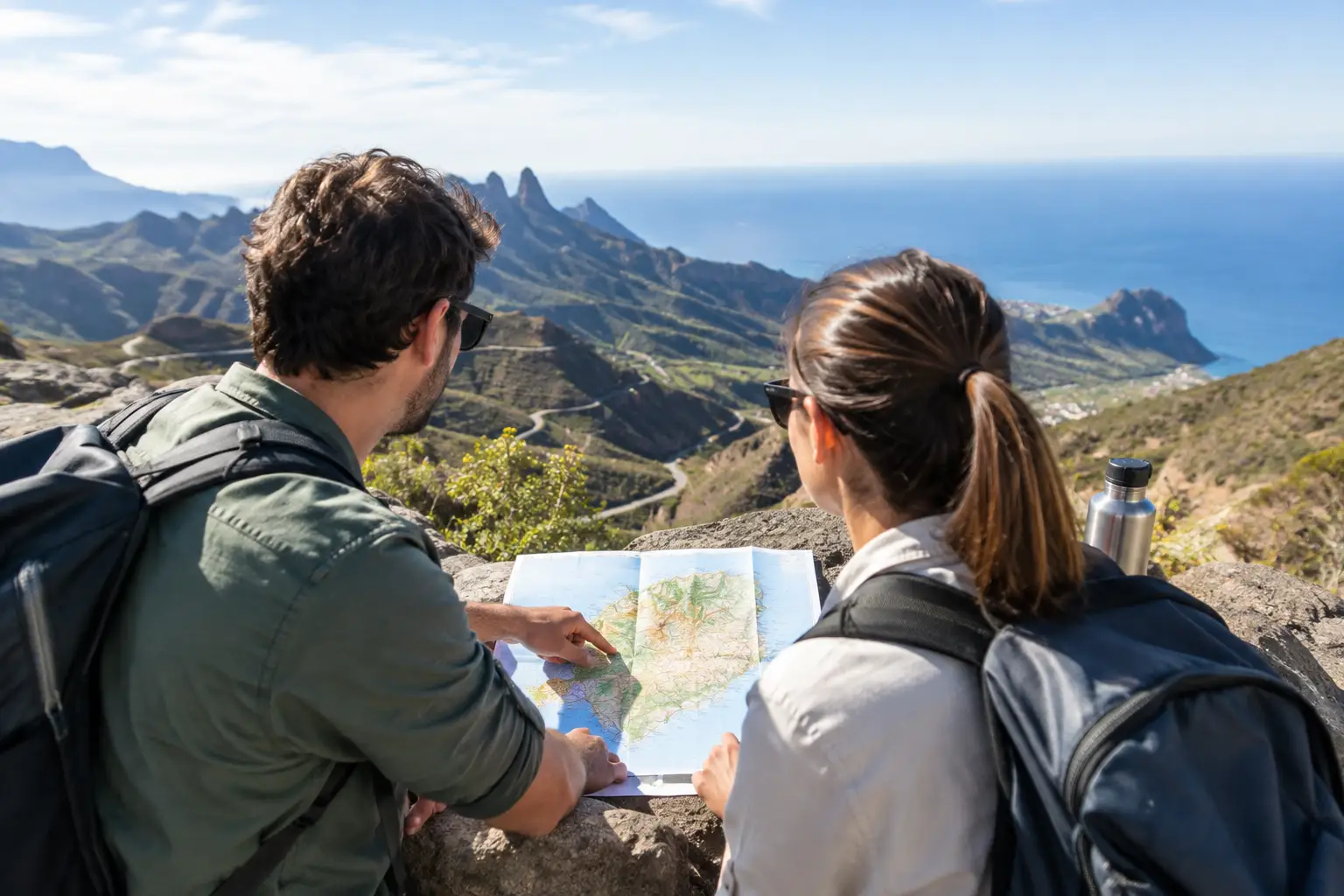
Gran Canaria Spatial Planning Guide: Understand the Island Before Choosing Your Hotel
Most holiday searches begin with hotels. A better starting point is understanding where those hotels are.
Gran Canaria offers a remarkable variety of coastal environments within a relatively small geographical area. Long promenades, sheltered bays, steep hillsides, sandy beaches, natural dune landscapes, fishing harbours and urban neighbourhoods create very different holiday experiences.
Two hotels in the same resort can have similar facilities and prices while offering completely different experiences once you step outside.
One may provide direct access to a coastal promenade. Another may overlook the same coastline from a hillside, with a considerably more demanding walking route to the beach.
This Gran Canaria spatial planning guide helps you understand these differences before booking.
Start by exploring Gran Canaria in VistaLINX. Build a mental map of the island, compare the different coastal environments and then assess individual hotels within their geographical context.
Start with the holiday you want, not the hotel
Before choosing accommodation, picture an ordinary day during your holiday.
Where would you like to walk after breakfast? How important is it to have restaurants nearby? Do you want to spend most afternoons on the beach or around the hotel pool? Would you enjoy a long evening stroll along the coast, or do you prefer the atmosphere of a compact harbour town?
These questions reveal something that hotel ratings cannot: the kind of geographical setting that supports your ideal holiday.
A hotel with spectacular hillside views may be perfect for someone who values scenery and intends to hire a car. The same property may be less suitable for someone who expects to walk to the beach several times a day.
Understanding the island's geography allows you to make these compromises intentionally rather than discovering them after arrival.
The southeastern coast: from Bahía Feliz to Maspalomas
The southeastern resort corridor offers a gradual transition between smaller coastal communities, larger tourist developments and the open natural landscape of the Maspalomas Dunes.
Although these destinations are relatively close to each other, their geographical characteristics create distinctly different holiday experiences.
Bahía Feliz
Bahía Feliz is a smaller, relatively self-contained resort community with landscaped accommodation complexes, restaurants and a compact commercial centre.
Its more exposed coastline, with rocky and pebbled sections, differs from the wider sandy beaches found farther west. The area is particularly associated with windsurfing and can appeal to travellers who appreciate a quieter resort setting.
Hotel facilities and immediate surroundings often play a significant role in the daily holiday experience.
Explore Bahía Feliz in 360° to understand the relationship between its accommodation, resort centre and shoreline.
San Agustín
San Agustín offers a quieter alternative to Playa del Inglés while retaining a substantial sandy beach, local restaurants, commercial facilities and coastal walking routes.
The terrain rises away from parts of the shoreline, creating important differences between beachfront accommodation and properties positioned higher up.
A hotel with an excellent sea view may involve a more demanding return journey from the beach than its location initially suggests.
Explore San Agustín in 360° to compare the beach, surrounding streets, hotel positions and coastal connections.
Playa del Inglés
Playa del Inglés is one of the largest and most varied resort environments on the island.
Its extensive accommodation areas, restaurants, shopping centres, entertainment venues and beach access points provide considerable choice. However, the resort is too large and geographically varied for its name alone to tell you much about an individual hotel's convenience.
Accommodation near the beach, beside the dunes or around inland commercial centres can support very different holiday routines.
Elevation also matters. Parts of the resort sit above beach level, making the location of access routes particularly important.
Explore Playa del Inglés in 360° to understand how the resort's different districts relate to the coastline, dunes and commercial areas.
Maspalomas
Maspalomas is defined by its relationship with one of Gran Canaria's most remarkable natural landscapes, the Maspalomas Dunes.
The dunes, golf course, residential areas, resort complexes and beach approaches create a more open geographical setting than many conventional coastal resorts.
However, open space should not be confused with unrestricted pedestrian access. The protected dune reserve and golf course grounds influence the routes available between accommodation and the coastline.
A hotel close to the dunes may therefore offer beautiful surroundings without necessarily providing convenient beach access.
Explore Maspalomas in 360° to see how the natural landscape shapes the surrounding accommodation areas and their connections to the coast.
Meloneras
Meloneras offers a more promenade-oriented resort environment, extending westwards from Maspalomas Lighthouse.
Larger hotels, landscaped surroundings, restaurants, shopping areas and coastal walking routes define much of its character.
It is particularly attractive to travellers who enjoy extended seafront walks and want access to both contemporary resort facilities and the wider Maspalomas landscape.
However, hotel position remains important. A property near the lighthouse, one farther west towards Playa de Meloneras and another set back from the coastline will each offer a different daily experience.
Explore Meloneras in 360° to understand the scale of the resort and the relationship between its hotels, promenade and neighbouring Maspalomas.
The southwestern coast: bays, valleys and hillsides
Travelling west from Meloneras, the coastal geography changes considerably.
The relatively open southern landscape gives way to a series of bays, valleys, rocky headlands and steep hillsides.
Here, elevation often becomes just as important as distance.
A hotel located only a short distance from the beach on a conventional map may sit considerably above it. Conversely, a property with a less impressive outlook may offer much easier access to restaurants, shops and beach-level facilities.
Understanding this geography can fundamentally change your hotel shortlist.
Arguineguín and Patalavaca
Arguineguín is both a coastal town and a holiday destination. Its fishing harbour, local neighbourhoods, restaurants and everyday services create a more mixed environment than many purpose-built resorts.
Neighbouring Patalavaca has a different coastal character, with accommodation arranged around beach areas, hillside development and the coastal road.
Both can appeal to travellers who want a combination of holiday facilities and a more established local environment.
The important consideration is how individual properties connect to the waterfront and neighbouring areas. Geographical proximity does not necessarily translate into a convenient pedestrian route.
Anfi del Mar
Anfi del Mar is visually defined by its sandy beach, marina and extensive resort development.
The beach forms a recognisable focal point, while the surrounding hillsides and larger accommodation complexes influence how visitors move through the area.
Travellers attracted by photographs of the beach should establish whether their shortlisted accommodation is directly connected to it or positioned elsewhere within the surrounding coastal landscape.
Puerto Rico
Puerto Rico occupies a valley opening towards the sea, with substantial accommodation development extending up both sides.
This geography creates some of the most significant differences in hotel accessibility along the southern coast.
Properties higher on the hillsides can offer impressive panoramic views across the bay and Atlantic Ocean. Properties closer to the valley floor may offer more convenient access to shopping areas, restaurants, transport and the beach.
Neither position is inherently better. The choice depends on whether you prioritise the view, everyday walking convenience or the facilities of the accommodation itself.
Explore Puerto Rico in 360° to understand the valley, surrounding hillsides and different hotel elevations before booking.
Amadores
Amadores has a distinctive beach-centred setting, with its sandy bay providing the main geographical focus.
However, much of the surrounding accommodation occupies elevated positions above the coastline.
The difference between staying beside the beach and overlooking it from the hillside can be considerable, particularly for families with young children or travellers who prefer to avoid steep walking routes.
Explore Amadores in 360° to see the relationship between the beach, surrounding roads, hillsides and resort developments.
Compare it with Explore Puerto Rico in 360° if you are deciding between a beach-focused bay and a larger valley resort with more extensive commercial facilities.
Playa del Cura and Taurito
Playa del Cura and Taurito offer smaller coastal environments with their own distinct geographical characteristics.
Their more contained settings can appeal to travellers who prefer a holiday centred around the accommodation and immediate surroundings.
However, these destinations should not automatically be considered more walkable simply because they are smaller.
Hillsides, roads, hotel entrances and the availability of local facilities can all influence the practical experience.
For these areas, assessing how much of the holiday you expect to spend within the resort, and how often you intend to travel elsewhere, is particularly important.
Puerto de Mogán: a different kind of coastal destination
Puerto de Mogán deserves separate consideration because its geographical character differs from much of the southwestern resort corridor.
Rather than being organised primarily around extensive hotel developments or a hillside valley, Puerto de Mogán has a recognisable harbour centre, with a marina, pedestrian streets, restaurants and a sandy beach within a relatively compact waterfront environment.
This can be particularly attractive to travellers who enjoy short, varied walks and evenings centred around a picturesque harbour.
The surrounding hills contribute significantly to its visual character, but accommodation outside the central waterfront may involve different distances and elevations.
Explore Puerto de Mogán in 360° to understand how the harbour, beach, surrounding streets and valley fit together.
If you are deciding between compact harbour life and an extended resort promenade, compare Puerto de Mogán directly with Explore Meloneras in 360° .
Las Palmas: a city and beach holiday
Las Palmas de Gran Canaria offers a fundamentally different alternative to the southern resort areas.
Here, the holiday takes place within an established city, with residential neighbourhoods, shopping streets, restaurants, cultural attractions and public transport forming part of the everyday environment.
Las Canteras Beach and its extensive promenade provide an attractive setting for travellers who want to combine beach activities with urban life.
However, choosing accommodation in Las Palmas requires a different approach from choosing a hotel in a compact southern bay.
The relationship between the hotel, the beachfront, surrounding neighbourhoods and the parts of the city you intend to explore becomes particularly important.
Consider Las Palmas if you want the experience of staying in a city with a beach, rather than staying in a resort with tourist facilities arranged around it.
Understanding elevation: the dimension that maps often hide
Gran Canaria is a volcanic island, and its topography plays an important role in the holiday experience.
This is especially apparent along the southwestern coast, where hotels can occupy substantially different elevations within the same resort.
A short horizontal distance does not reveal how much effort a journey requires.
A property overlooking a beach may appear closer to it than another property when viewed from above. Yet the second property may provide a much easier walking route because it sits at beach level.
Elevation affects more than beach access. It can influence restaurant choices, shopping trips, evening walks and how frequently you return to your accommodation during the day.
For travellers with reduced mobility, families with pushchairs and anyone who prefers relatively effortless walking, these differences deserve particular attention.
Read our guide to comparing resort terrain in Gran Canaria and explore the island's geographical settings visually before deciding.
A beautiful view from above is not the same as convenient access from below.
Distance is not the same as accessibility
Hotel listings frequently describe accommodation as being a certain distance from the beach or resort centre.
While useful, this information does not necessarily explain the actual journey.
Road crossings, slopes, stairs, large resort grounds, protected natural areas and indirect pedestrian routes can all change the practical meaning of a geographical distance.
The hotel's entrance is often more relevant than the centre of its map marker.
For beach-focused holidays, our guide to assessing beach access in Gran Canaria provides additional considerations.
Travellers planning a Gran Canaria holiday without a car should give particular attention to the connections between accommodation, restaurants, shops and public transport.
The objective is not necessarily to minimise every distance. It is to understand which journeys will become part of your everyday holiday.
Which geographical setting suits your holiday?
Different priorities naturally lead towards different parts of the island.
For long coastal walks and promenade life: explore Explore Meloneras in 360° and Explore San Agustín in 360° .
For a compact harbour and beach environment: explore Explore Puerto de Mogán in 360° .
For a wider choice of restaurants, shopping and resort activities: explore Explore Playa del Inglés in 360° and Explore Puerto Rico in 360° .
For a holiday shaped by open natural landscapes: explore Explore Maspalomas in 360° .
For a distinctive beach-centred bay: explore Explore Amadores in 360° .
For a smaller, more contained resort setting: explore Explore Bahía Feliz in 360° .
These are starting points for exploration rather than definitive recommendations. Your individual hotel position can significantly influence how well any of these destinations matches your expectations.
Build a mental map before building a hotel shortlist
A more informed hotel search follows a simple sequence.
- Decide what kind of holiday experience you want.
- Identify the geographical settings that support that experience.
- Explore the relevant destinations visually.
- Assess individual hotel positions, terrain and walking routes.
- Compare hotel facilities, reviews, availability and prices.
This reverses the conventional booking process, where travellers often discover the geography only after becoming interested in a particular hotel.
Our guide to comparing hotel surroundings in Gran Canaria helps you make the transition from choosing an area to choosing a specific property.
Explore Gran Canaria in 360°
VistaLINX allows you to explore connected geographical environments before committing to accommodation. See the coastline, surrounding terrain, resort development and hotel locations within their wider context.
Start your exploration with any of these destinations:
- Gran Canaria Explorer
- Explore Bahía Feliz in 360°
- Explore San Agustín in 360°
- Explore Playa del Inglés in 360°
- Explore Maspalomas in 360°
- Explore Meloneras in 360°
- Explore Puerto Rico in 360°
- Explore Amadores in 360°
- Explore Puerto de Mogán in 360°
Compare destinations from different perspectives. Follow the coastline, examine the surrounding terrain and understand how the places you intend to visit relate to each other.
Hotel reviews tell you what other people experienced. Hotel photographs show you what the property looks like. Visual exploration helps you understand whether its location supports the holiday you want.
You are booking a hotel, but you are choosing an environment.
See the context before you make the choice.
VistaLINX | Insight in Sight
See the context
Explore Gran Canaria visually
Use VistaLINX to compare resort areas, hotel zones, beaches, promenades and terrain before choosing where to stay.