
VistaLINX Gran Canaria guide
Resort Walkability in Gran Canaria: What Matters
Resort walkability in Gran Canaria depends on promenade continuity, slopes, beach access and hotel position. Compare the right area before booking a stay.
Published 2 November 2026
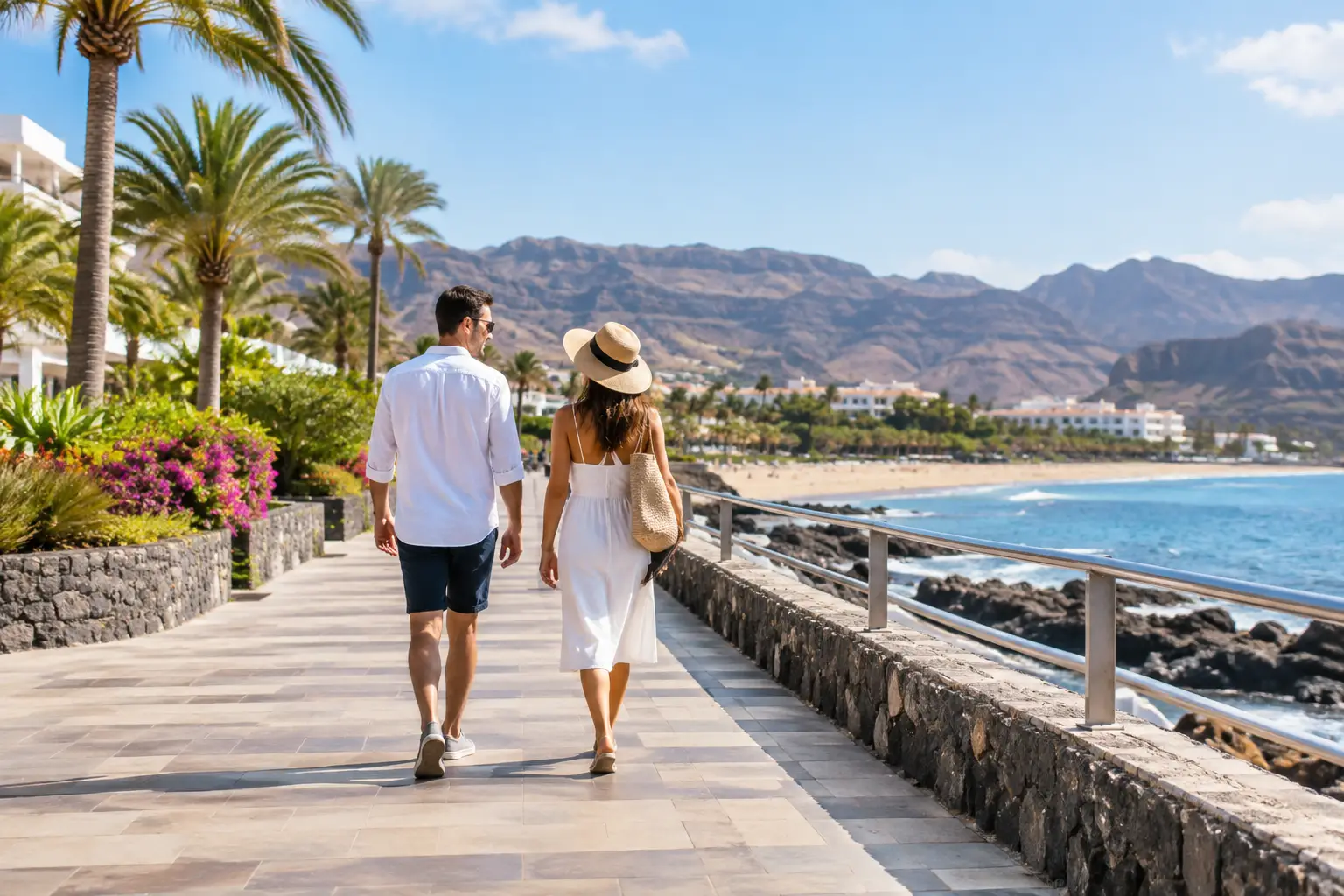
Resort Walkability in Gran Canaria: What Matters
A hotel can look close to the beach on a map and still make everyday walking surprisingly inconvenient.
That is because resort walkability in Gran Canaria is shaped by more than distance.
The route between your hotel, beach, promenade, shops and evening choices may involve slopes, road crossings, steps or a long detour around the resort.
So the useful question is not:
“Can I walk there?”
Ask instead:
“Will I want to walk this route several times a day?”
That changes the decision.
For travellers without a car, it can matter more than many hotel facilities.
A resort may be compact but steep.
Another may cover a large area while offering easy coastal walking.
A third may feel level around the centre while hotel accommodation climbs the surrounding slopes.
The area matters.
The exact hotel position matters even more.
What resort walkability actually means
Walkability begins at area level, but it never applies equally to every hotel inside that area.
Start by looking at four things:
the continuity of the seafront;
the terrain;
the relationship between hotel zones and everyday services;
and whether the resort follows one clear route or spreads across several levels.
Then move to the individual property.
Which side of the main road is it on?
Is it close to the part of the resort you will actually use?
What lies between the entrance and the beach?
A walkable resort does not have to be small.
Playa del Inglés, for example, covers a broad developed area.
Some hotel positions still provide straightforward access to long walking routes, restaurants, shops and the coast.
A smaller bay can create the opposite situation.
Beach, restaurants and accommodation may look tightly grouped together, while the hotel itself sits high above them.
Size does not decide walkability.
The route does.
Repetition is what makes a route important
One walk rarely tells you whether a hotel location works.
Think about repetition.
Breakfast supplies.
A morning beach visit.
Back to the room.
Out again in the afternoon.
Dinner.
The walk home.
A route that seems perfectly acceptable once can feel very different after repeating it several times.
That is why the return journey matters as much as the outward one.
Walkability is not simply about reaching somewhere.
It is about whether the route supports the rhythm of the holiday you want.
Meloneras: promenade continuity
Meloneras has one of the clearest coastal walking structures on Gran Canaria.
The promenade creates a continuous orientation line through much of the resort, linking hotels, restaurants and waterfront scenery.
For travellers who enjoy walking before or after dinner, that is a major advantage.
But hotel position still changes the experience.
A property close to the promenade gives you immediate access to that route.
Move farther inland and some of the practical value disappears.
So “Meloneras is walkable” is not quite enough.
The more useful question is:
“How directly does this hotel connect with the Meloneras promenade?”
Maspalomas: a larger landscape
Maspalomas creates a different walking problem.
The dunes, golf areas, larger hotel plots and more dispersed development make the destination feel open and spacious.
That does not automatically make everyday walking difficult.
It does mean that useful destinations can be farther apart.
A hotel near the lighthouse and coastal zone has a very different walking context from one farther inland.
Beach access, restaurants and everyday services are not distributed evenly across the wider area.
Maspalomas therefore needs to be read at hotel level.
Do not assume the destination name tells you how easily you will move around from a particular property.
Playa del Inglés: large does not mean unwalkable
Playa del Inglés is one of the best examples of why resort size and walkability should not be confused.
Explore Playa del Inglés in 360°
The area is extensive.
It also contains long pedestrian routes, several commercial zones, beach approaches and connections towards Maspalomas.
Some hotel locations make it easy to combine walking, restaurants, shopping and beach access.
Others place you farther from the particular part of the resort you are most likely to use.
A straight line to the beach is not enough.
Look at which route the hotel naturally connects with.
The nearest commercial centre may not be the one where you want to spend the evening.
The nearest part of the coast may not be the most convenient beach access point.
That is why exact position matters.
Puerto Rico: compact resort, major elevation differences
Puerto Rico looks compact from above.
Then you notice the terrain.
The bay, marina and lower resort areas sit inside a valley, while accommodation spreads onto the surrounding slopes.
That creates very different walking conditions within one resort.
A hotel near lower ground may connect naturally with the beach, restaurants and central services.
A higher property may give you more separation and wider views, while making the return journey more demanding.
For a deeper comparison, see Is Puerto Rico Gran Canaria Walkable?.
The important question is not whether Puerto Rico is walkable in general.
It is whether the routes from your particular hotel work for you.
Amadores: beach centred, but not uniformly level
Amadores is organised around a very clear bay.
That makes the beach easy to understand visually.
Hotel positions are more varied.
Some accommodation connects closely with beach level.
Other properties sit above the bay.
If your holiday is mainly about spending long periods on one beach, that can still work very well.
But repeated trips between hotel, beach and evening activities may feel different depending on the elevation.
The coastal connection towards Puerto Rico also adds options.
A route can exist without being equally convenient from every hotel.
Again, the starting point matters.
San Agustín: quieter coastal walking
San Agustín generally offers a more linear coastal environment.
The beachfront parts of the area can work well for travellers who value a calmer walking routine and easier connection with the coast.
But San Agustín is not uniformly flat.
Some accommodation sits farther back or higher above the shoreline.
The promenade may be close.
The hotel entrance may not be.
So inspect the actual connection between property, beach and coastal walking route.
For many travellers, San Agustín can offer a useful middle ground between a large resort environment and a more contained hotel base.
Bahía Feliz: compact does not mean everything is nearby
Bahía Feliz has a more contained resort character.
That can make it easier to understand.
It does not automatically mean every daily service or walking route sits immediately outside every hotel.
If the hotel itself will provide much of the holiday, that may not matter.
If you expect to walk out for different meals, shops and evening activity, inspect what actually surrounds the accommodation.
Contained and walkable are not the same thing.
Puerto de Mogán: walkable centre versus hotel access
Puerto de Mogán is often attractive to travellers who want a compact harbour setting.
Explore Puerto de Mogán in 360°
The marina, beach and central streets form a recognisable local environment.
Once you are inside that core, orientation is relatively simple.
But that does not tell you how easy it is to reach the core from every hotel.
Accommodation farther behind or above the waterfront can create a different walking pattern.
So separate two questions:
“Is Puerto de Mogán easy to walk around?”
and
“Is my hotel easy to walk from?”
They are not necessarily the same answer.
Arguineguín: walking inside a real town
Arguineguín has a different kind of walkability.
It is a functioning coastal town as well as a visitor destination.
That means supermarkets, local streets, restaurants and everyday services form part of the walking environment.
For some travellers, that is ideal.
You are not simply walking through a resort.
You are moving through a place where people live.
But hotel positions vary.
Some connect naturally with the waterfront and town centre.
Others sit higher or farther away.
The local context is a strength only if your particular location lets you use it.
Patalavaca and Anfi del Mar: nearby does not mean identical
Patalavaca and Anfi del Mar sit close together geographically.
Their walking environments are different.
Patalavaca combines coastal development with accommodation climbing behind the shoreline.
Anfi del Mar has a more concentrated beach and marina setting.
That can make the immediate waterfront easy to understand.
But again, the hotel position decides whether that waterfront is naturally part of your day.
Do not treat neighbouring areas as interchangeable simply because they appear close together on a map.
Roads and crossings matter too
Terrain gets much of the attention, but roads can change walkability just as much.
Two hotels may sit the same distance from the coast.
One connects with the promenade through a simple pedestrian route.
The other requires a crossing, a detour or movement around larger resort development.
That difference matters.
When studying a hotel, follow the likely route rather than drawing a straight line.
Look for crossings.
Look at where the promenade begins.
Check whether the beach route reaches a usable access point.
And think about the same journey after dinner.
Not as a question of safety.
Simply ask whether it is the kind of ordinary walk you will actually enjoy repeating.
Resort walkability by holiday style
Different travellers need different versions of walkability.
Couples who enjoy a coastal walk before or after dinner may find Meloneras, seafront parts of Playa del Inglés, San Agustín or central Puerto de Mogán especially relevant.
Families may care more about reducing repeated effort.
A hotel close to the beach and a modest cluster of restaurants and shops can work better than a larger resort with more choice spread across several zones.
Amadores, Anfi del Mar and lower parts of Puerto Rico are worth comparing with that in mind.
Travellers who prefer local streets and everyday services may lean towards Arguineguín.
Las Palmas de Gran Canaria offers another type of walking environment entirely.
It is a city.
That means pavements, neighbourhoods, shops, restaurants and urban movement rather than a purpose built resort network.
Explore Las Palmas de Gran Canaria in 360°
Choose it because you want that city context.
Not because it is another version of a southern resort.
Build the mental map before choosing the hotel
Start with the area.
Find the coast.
Find the main roads.
Look at the direction of the slopes.
Identify the promenade.
See where restaurants and services are concentrated.
Then place the hotel inside that geography.
Ask four practical questions:
Can I reach the beach without an awkward route?
Can I reach food and everyday services easily?
Will the return walk still suit me?
And does the surrounding area match the rhythm of holiday I want?
If the answers work, the area and hotel probably fit together.
If they do not, changing the hotel may solve the problem without changing the resort.
Explore walkability in 360°
Use the VistaLINX area views to compare promenade continuity, terrain, roads and hotel positions before narrowing your shortlist.
Explore Playa del Inglés in 360°
Explore Puerto de Mogán in 360°
The strongest choice is rarely the resort described as “most walkable”.
It is the one where the routes you actually expect to use are easy enough to repeat.
That is the difference.
You do not live inside the resort average.
You walk from one exact hotel.
See the context
Explore Gran Canaria visually
Use VistaLINX to compare resort areas, hotel zones, beaches, promenades and terrain before choosing where to stay.