
VistaLINX Gran Canaria guide
Meloneras versus Puerto de Mogán: Which Fits?
Compare Meloneras versus Puerto de Mogán by beach setting, walking layout, dining, scenery and location before choosing your hotel stay in Gran Canaria.
Published 13 October 2026
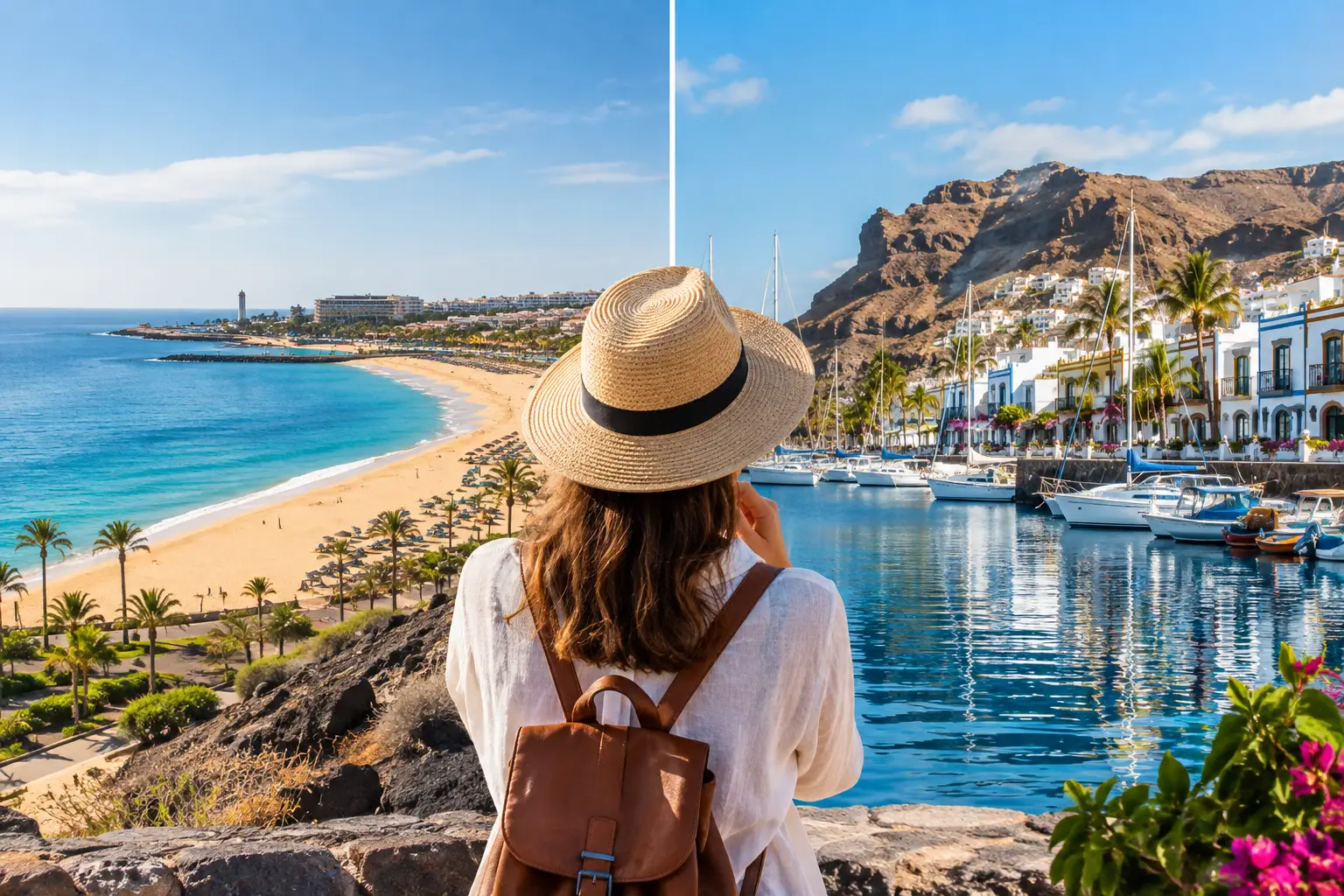
Meloneras versus Puerto de Mogán: Which Fits?
Choosing between Meloneras and Puerto de Mogán is less about deciding which place looks prettier and more about deciding how you want your holiday surroundings to work each day.
Meloneras is a developed coastal resort beside Maspalomas, with a long promenade, large hotels, restaurants and easy visual connection towards the lighthouse and dunes. Puerto de Mogán is a smaller, more self contained harbour and beach setting, where the marina, waterfront streets and accommodation occupy a tighter coastal pocket.
Both can work for couples, families and independent travellers. But once you leave the hotel, they create quite different routines.
Build a mental map first. Then decide whether you want a connected coastal resort that opens into the wider Maspalomas area, or a more compact base where the harbour, beach and evening environment sit closer together.
Meloneras versus Puerto de Mogán: the core decision
Choose Meloneras if you want a polished coastal resort with a promenade that gives you several directions to walk, a broad choice of nearby restaurants and easy connection towards Maspalomas.
It works particularly well when you want your hotel area to feel like part of a larger southern resort landscape rather than a destination with one obvious centre.
Choose Puerto de Mogán if you prefer a more concentrated harbour and beach setting where much of the day can happen within the same local area.
The marina, waterfront streets and beach create a recognisable centre. That can make the resort easier to understand at first glance, although hotel position still matters because accommodation extends away from the waterfront and onto higher ground.
Neither area is automatically better.
A traveller who values long coastal walks, resort variety and proximity to Maspalomas may find Puerto de Mogán too contained. Someone who prefers a defined local centre may find Meloneras more spread out and resort oriented than necessary.
Meloneras gives you a connected coastal environment
Meloneras follows the coast west of the Maspalomas lighthouse.
The seafront promenade is one of the strongest organising features of the area. Hotels, restaurants, shops and coastal viewpoints sit along or behind this route, making the waterfront useful for more than simply reaching the beach.
That gives Meloneras a particular advantage if walking is part of your holiday routine.
You can leave a hotel near the seafront, walk for dinner, continue towards the lighthouse and connect visually with the wider Maspalomas landscape without treating each activity as a separate journey.
The area is not one uniform strip, however.
Some hotels sit directly beside the promenade. Others are positioned behind larger resort plots or farther inland. A property marketed as Meloneras can therefore have a very different relationship with the coast from another hotel carrying the same area name.
The important question is not simply whether the hotel is in Meloneras. It is how naturally the hotel entrance connects with the promenade and the section of the coast you expect to use.
Puerto de Mogán gives you a clearer local centre
Puerto de Mogán has a different spatial logic.
The marina, harbour side streets and beach create a compact coastal core. Instead of following a long resort frontage, much of the local activity is concentrated around this smaller environment.
That can make everyday decisions simple.
Beach time, a waterfront walk and dinner can all happen within the same local setting without needing to move between several parts of a larger resort.
But compact does not mean every hotel is equally convenient.
Accommodation extends behind and around the coastal core, and some properties sit farther from the marina or on higher ground. A hotel overlooking Puerto de Mogán may therefore offer a very different walking pattern from one closer to the waterfront.
This is where a conventional booking map can be misleading. Two hotels may both appear to belong to Puerto de Mogán while creating very different routes to the beach and harbour.
Explore Puerto de Mogán in 360°
Beach setting: broad coastal choice or compact beach routine?
Meloneras gives you access to several different coastal experiences.
The immediate shoreline includes promenade sections, rocky frontage and beach areas, while the broad Maspalomas beach and dune landscape sits nearby.
This gives you more flexibility if different members of your group want different things from the coast. One person can prioritise a long walk while another may prefer a shorter beach visit or lunch beside the promenade.
The trade off is that being close to the sea does not automatically mean being close to the particular section of sand you expect to use.
A hotel may have excellent access to the promenade while still requiring a longer walk to your preferred beach entrance.
That is why it is worth checking how to assess beach access before booking rather than judging the hotel only by coastal distance.
Puerto de Mogán offers a simpler relationship between beach and centre.
The beach sits beside the marina environment, so swimming, waterfront dining and harbour walking can fit naturally into the same part of the day.
For some travellers, that compactness is exactly the attraction.
For others, particularly on a longer stay, the smaller coastal footprint may provide less variety than the wider Meloneras and Maspalomas setting.
Evening life: promenade or harbour?
Meloneras tends to create an evening routine based around movement along the coast.
Restaurants and resort activity are distributed along the promenade and surrounding commercial areas. This gives you more choice of direction and makes an evening walk part of the experience itself.
Hotel position still changes the result.
A property beside the promenade may make several dining options feel immediately accessible, while accommodation farther inland can turn the same places into a more deliberate walk.
Puerto de Mogán concentrates the evening environment more clearly around its harbour and adjoining streets.
This can suit travellers who prefer a recognisable centre where dinner and an evening stroll happen in the same compact area.
The distinction is therefore less about which destination has restaurants and more about how those restaurants relate to the place where you are staying.
Meloneras offers a longer resort corridor.
Puerto de Mogán offers a tighter local centre.
Walking without a car
For travellers planning a car free holiday, the difference between the two areas becomes especially useful.
In Meloneras, ask how the hotel connects with the promenade and which direction you expect to walk most often. A good seafront position can make restaurants, coastal walks and Maspalomas feel naturally connected.
In Puerto de Mogán, ask whether the hotel sits within the harbour and beach core or farther back from it.
A compact resort can still create an inconvenient routine if the hotel itself sits above or beyond the part of the area you intend to use every day.
The return journey matters as much as the outward one.
A location that looks close to the waterfront may feel very different after dinner if the hotel sits on higher ground.
Hotel position can reverse the area comparison
An area comparison gets you most of the way towards the right decision.
The hotel marker finishes the job.
In Meloneras, a hotel near the lighthouse side can connect naturally with Maspalomas as well as the Meloneras promenade. A property farther west may create a stronger relationship with its immediate resort surroundings instead.
In Puerto de Mogán, accommodation near the beach and marina can produce a compact walking holiday. A property farther back or higher above the coastal core may turn the same destination into a more hotel centred stay.
Before booking, inspect the exact hotel position.
Look at the route to the coast, the roads immediately around the property, the main walking areas and the relationship between the hotel and the place where you expect to spend your evenings.
A sea view tells you what you can see.
It does not necessarily tell you how easily you can reach it.
Explore the areas in 360°
Use the VistaLINX area views to compare the coastline, promenade, terrain and hotel surroundings before narrowing your shortlist.
Explore Puerto de Mogán in 360°
Maspalomas provides useful context for the wider environment that Meloneras connects into.
Taurito provides a useful comparison with the more enclosed south west resort geography near Puerto de Mogán.
For a broader decision framework, see How to Choose Gran Canaria Resort Areas Well.
Which one should you choose?
Choose Meloneras when a long coastal promenade, access towards Maspalomas and a larger resort environment matter more than having one compact centre.
Choose Puerto de Mogán when you want the beach, marina and evening area to form a more concentrated daily base, and you are comfortable staying farther from the main southern resort corridor.
Then test the individual hotel against that choice.
Follow the route from its entrance to the coast. Look at what sits immediately around it. Consider where you will probably walk after breakfast and where you will return from after dinner.
The better destination is not the one with the most attractive resort name.
It is the one whose everyday geography matches the holiday you actually want to have.
See the context
Explore Gran Canaria visually
Use VistaLINX to compare resort areas, hotel zones, beaches, promenades and terrain before choosing where to stay.