
VistaLINX Gran Canaria guide
Which Area Has Flat Promenades in Gran Canaria?
Which areas have flat promenades in Gran Canaria? Compare waterfront routes, hotel access, terrain and slopes before choosing where to stay.
Published 21 September 2026
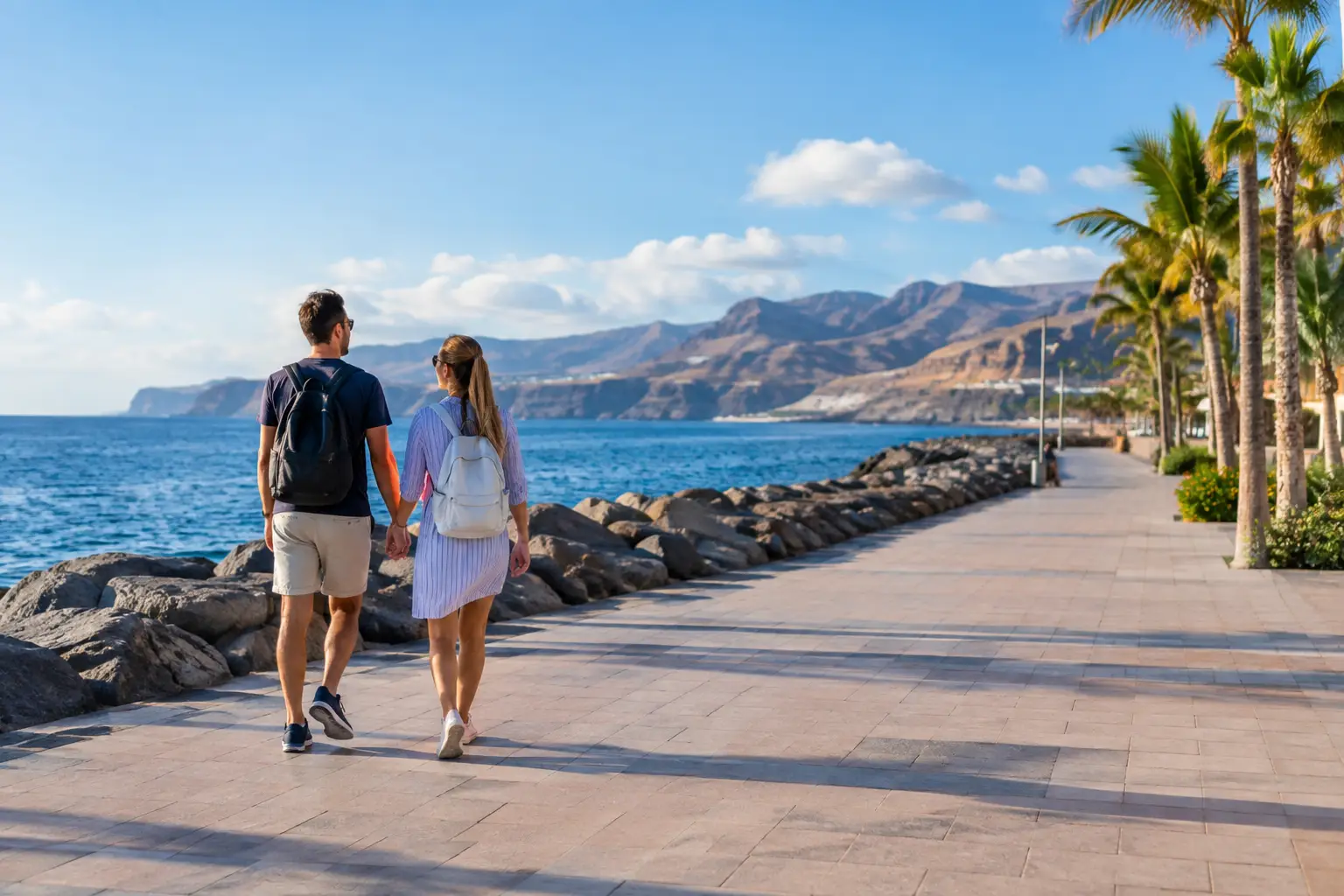
A coastline can look flat on a map and still create a surprisingly demanding daily walk.
If you are asking which areas have flat promenades in Gran Canaria, the useful answer is not simply a resort name.
You need to separate two things:
the waterfront route itself
and the route between that waterfront and your hotel.
A promenade can be broad and almost level while accommodation rises steeply behind it. Another hotel may be slightly farther from the sea but connect to the promenade by an easy, level street.
This distinction matters when travelling with a pushchair, reduced mobility, beach equipment, or simply because you want relaxed evening walks rather than repeated climbs.
Build a mental map before booking.
What does “flat promenade” actually mean?
For most holiday planning, flat does not mean mathematically level.
It means that the main walking route between beach, restaurants, shops and the waterfront does not require a sustained climb.
Three questions matter.
Is the seafront route itself broadly level?
Does it continue far enough to be useful?
Can you reach it easily from your hotel?
The third question often changes the answer.
A beautiful promenade is much less useful when every walk ends with a steep return to your accommodation.
Las Canteras: the strongest long urban promenade
Las Canteras in Las Palmas de Gran Canaria is one of the clearest choices when long, mostly level waterfront walking is a major priority.
The beach and promenade run through a dense urban environment where restaurants, cafés, shops and everyday services sit close to the coast.
This creates a very different walking experience from a hillside resort.
You can spend substantial parts of the day moving along the beachfront without repeatedly changing level.
The important qualification is hotel position.
A hotel near Las Canteras can provide very easy access.
A property several blocks inland may still be in the same neighbourhood but create a different daily route.
Choose Las Palmas when you want the beach promenade to function as part of city life rather than as the centre of a self contained resort.
Explore Las Palmas de Gran Canaria in 360°
Meloneras: the strongest southern resort option
Meloneras is one of the clearest southern choices when a broad, promenade led resort environment matters.
The seafront extends west from the Maspalomas lighthouse through hotel, restaurant and coastal walking areas.
Much of the promenade itself is comfortable for relaxed walking.
The other advantage is spatial clarity.
Restaurants, hotels and evening activity frequently relate directly to the coastal route, so the promenade becomes part of the daily resort experience rather than somewhere you travel to separately.
But even Meloneras requires a hotel level check.
Properties directly connected to the seafront create the easiest walking pattern.
Hotels farther inland or positioned behind larger plots may require a longer approach.
Compare hotels near the Meloneras promenade
Puerto de Mogán: a compact flat core
Puerto de Mogán offers a different type of easy walking.
Its harbour, marina, pedestrian streets, restaurants and nearby beach form a relatively compact core.
This is not the same as having a long coastal promenade like Las Canteras or Meloneras.
Its strength is that many of the places you are likely to use can sit within a manageable local walking environment.
That can be particularly attractive when you want short evening walks rather than kilometres of uninterrupted seafront.
The qualification is terrain outside the core.
Accommodation extends away from the harbour and into areas where elevation can change.
A flat marina does not mean every Puerto de Mogán property provides flat access to it.
Explore Puerto de Mogán in 360°
Playa del Inglés: plenty of walking, but not one flat promenade
Playa del Inglés has many walkable resort streets and extensive beach frontage.
But it should not be described as one continuous flat promenade environment.
The resort occupies a large developed area above and behind parts of the beach.
Depending on your hotel, access to the shoreline can involve ramps, steps, slopes or particular beach approaches.
This means Playa del Inglés can work very well for walking while still being less straightforward than Meloneras or Las Canteras.
Choose carefully when avoiding gradients is important.
Look at the hotel entrance and trace the actual route towards the beach and the part of the resort you expect to use in the evening.
Explore Playa del Inglés in 360°
Maspalomas: flatter areas, but distances matter
Parts of Maspalomas are relatively gentle in terrain, but the resort is geographically spread out.
The dunes, golf areas, inland hotel zones and lighthouse end create different walking environments.
A hotel near the lighthouse can connect naturally with coastal routes and Meloneras.
A hotel farther inland may sit on relatively manageable terrain but still require considerably more walking to reach the beach.
This is therefore less a question of steepness and more one of distance and route.
A flat route can still become inconvenient when you have to walk much farther than expected.
San Agustín: useful coastal walking, but not uniformly level
San Agustín has attractive coastal walking sections and can work well for travellers looking for a quieter southern base.
But the wider area should not be treated as completely flat.
Accommodation sits at different levels behind the shoreline, and some routes between hotel zones and coastal sections involve changes in elevation.
The seafront itself may work well for your routine while the hotel approach does not.
That distinction should be checked before booking.
Amadores: flat beach level, steep hotel geography
Amadores is a perfect example of why the promenade and hotel position must be evaluated separately.
The beachfront environment itself is relatively straightforward.
You can walk around the bay and use restaurants and beach facilities at coastal level.
But accommodation rises substantially behind the beach.
A hotel can overlook Amadores from relatively close range while requiring a significant downhill journey to the bay and an uphill return.
If easy level walking is important, do not simply ask whether Amadores has a promenade.
Ask where your hotel sits relative to it.
Puerto Rico: the lower resort is easier than the slopes
Puerto Rico follows a similar logic.
The lower part of the resort around the beach, marina and central facilities can work reasonably well on foot.
Accommodation then climbs the surrounding valley sides.
That means two Puerto Rico hotels can provide completely different walking experiences.
For travellers prioritising easy movement, lower elevation matters more than panoramic views.
See whether Puerto Rico works for walking
Patalavaca and Anfi del Mar
Patalavaca and Anfi del Mar both provide useful coastal walking environments in places.
Anfi in particular has a concentrated beach and marina setting where movement around the immediate resort can be straightforward.
But surrounding accommodation and roads can rise quickly away from the coast.
Patalavaca also combines coastal sections with changing terrain behind them.
These areas can therefore work very well when the hotel sits close to the waterfront.
They become less attractive for someone seeking completely effortless access when accommodation is positioned higher.
Playa del Cura and Taurito: compact does not mean flat
Playa del Cura and Taurito are geographically contained resort settings.
That can make them appear simple to navigate.
But both sit within the more dramatic southwest coastal terrain where hotels can occupy different levels above the shoreline.
The immediate beachfront may provide easy local walking.
The route from accommodation to that waterfront is the part that deserves inspection.
Explore Playa del Cura in 360°
The most important distinction: promenade versus hotel access
This is the mistake worth avoiding.
A resort can have an excellent promenade and still be the wrong choice for someone who struggles with slopes.
The promenade describes the waterfront.
It does not describe the relationship between your room and that waterfront.
When comparing hotels, identify:
the hotel entrance
the nearest promenade access
the elevation between them
steps or ramps
road crossings
the direction of restaurants and shops
the route you will walk back after dinner
That final return journey may matter more than the promenade itself.
See what hotel surroundings mean in Gran Canaria
Explore the Areas in 360°
For the strongest long promenade environments:
Explore Las Palmas de Gran Canaria in 360°
For a compact harbour environment:
Explore Puerto de Mogán in 360°
For southern resort comparisons:
Explore Playa del Inglés in 360°
For bay resorts where hotel elevation matters:
Which area has the flattest long promenade?
Las Canteras in Las Palmas is one of the strongest choices for a long urban waterfront walk.
Meloneras is one of the strongest southern resort alternatives.
The better choice depends on whether you want a city and beach environment or a purpose built resort setting.
Which southern Gran Canaria resort is best for flat evening walks?
Meloneras is usually the clearest starting point because much of the resort environment relates directly to its coastal promenade.
The exact hotel position should still be checked before booking.
Is Puerto de Mogán flat?
The harbour and marina core is relatively easy to walk.
The wider accommodation area is not uniformly flat, so hotel position determines whether that easy walking continues all the way to your door.
Are Puerto Rico and Amadores flat?
At beach level, parts of both areas can be easy to walk.
The surrounding hotel geography is much steeper.
A lower hotel position can therefore create a completely different experience from accommodation higher on the slopes.
The practical choice
Choose Las Canteras when you want a long urban beachfront promenade.
Choose Meloneras when you want a mostly level promenade within a southern resort environment.
Choose Puerto de Mogán when a compact, easy harbour and beach core is enough.
Consider Playa del Inglés, Maspalomas and San Agustín when you want broader southern resort options but are prepared to inspect the exact hotel route carefully.
In Puerto Rico, Amadores and the smaller southwest bays, prioritise hotel elevation before assuming that a flat waterfront means a flat holiday.
The right question is not:
“Does this resort have a promenade?”
It is:
“Can I reach the promenade from my hotel in the way I want to walk every day?”
See that relationship before you decide.
See the context
Explore Gran Canaria visually
Use VistaLINX to compare resort areas, hotel zones, beaches, promenades and terrain before choosing where to stay.