
VistaLINX Gran Canaria guide
Las Palmas or South Gran Canaria: Which Area Fits Your Holiday?
Compare Las Palmas and south Gran Canaria by beach setting, walkability, resort atmosphere and hotel context before deciding where to stay.
Published 4 September 2026
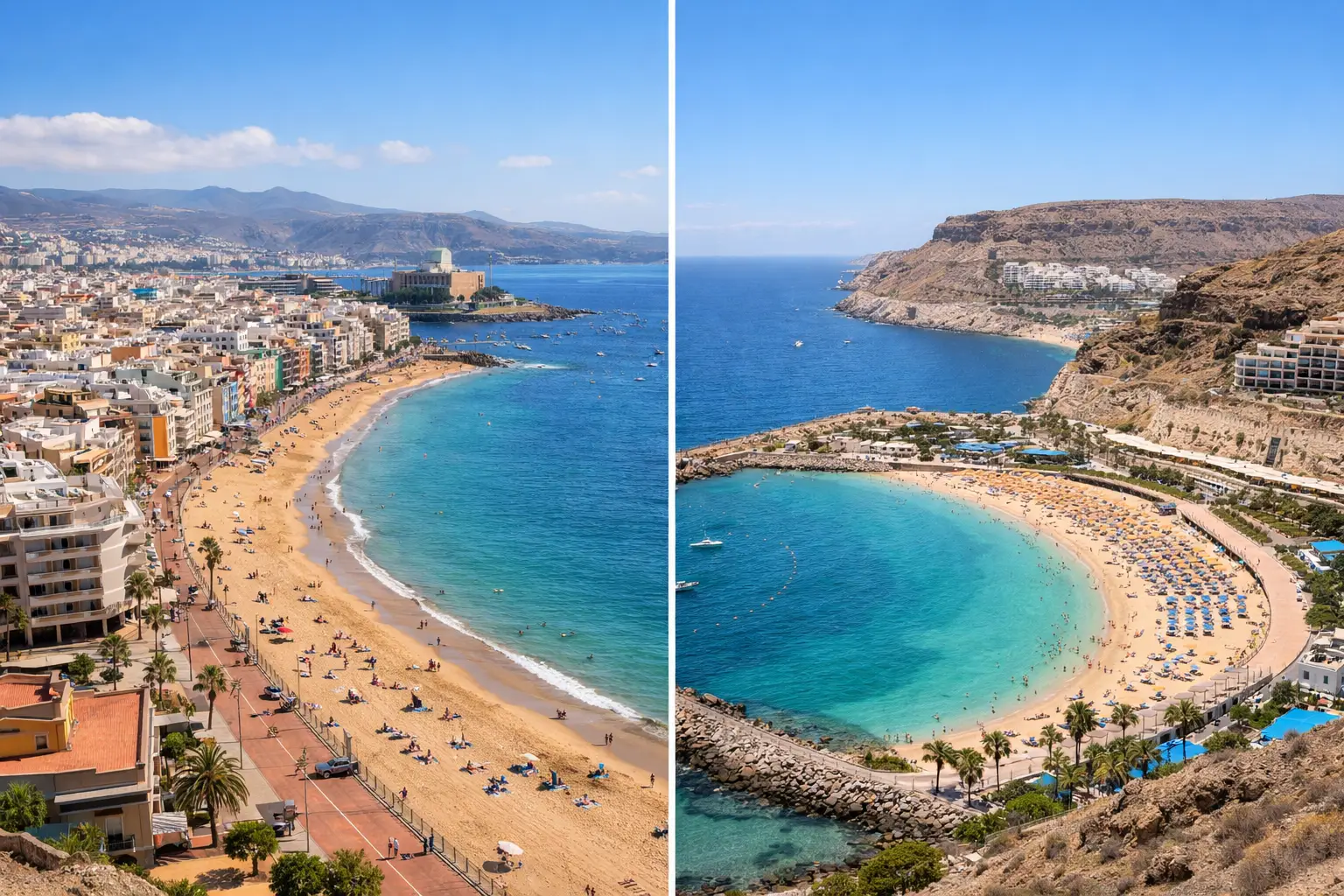
Choosing between Las Palmas and south Gran Canaria is not simply a choice between north and south. It changes the structure of the whole holiday.
In Las Palmas de Gran Canaria, the beach forms part of a working city. Restaurants, cafés, shops, museums, residential streets and everyday services surround the visitor experience.
In the south, the beach, promenade, hotel zones and visitor services are more likely to form the centre of daily life. Even there, however, the coastal areas are not interchangeable. Playa del Inglés, Meloneras, Puerto Rico and Puerto de Mogán provide very different relationships between hotel, beach, terrain and evening activity.
The useful question is therefore not which side of Gran Canaria is universally better.
It is whether you want the city to be part of the holiday, or whether you want a coastal resort setting to organise more of the day for you.
Before comparing individual hotels, see how the wider resort areas relate:
https://grancanaria.vistalinx.com/gran-canaria-resorts
Las Palmas or south Gran Canaria: the short answer
Choose Las Palmas de Gran Canaria when you want an urban beach, neighbourhood restaurants, city streets and greater independence from a resort environment.
Choose Playa del Inglés when you want a large beach, restaurants, shops and a broad choice of accommodation and evening activity.
Choose Maspalomas when dunes, open space and long beach walks matter more than having everything concentrated within one compact centre.
Choose Meloneras when you prefer a polished promenade, larger hotels and calmer evenings beside the coast.
Choose San Agustín or Bahía Feliz when a quieter southern base matters more than nightlife or extensive restaurant choice.
Choose Puerto Rico or Amadores when sheltered bays and resort convenience appeal, but examine hotel elevation carefully.
Choose Arguineguín or Patalavaca when you want more everyday town context alongside the coast.
Choose Puerto de Mogán when you value a compact harbour setting and slower evenings.
The final decision should always be based on the exact hotel position, not the destination name alone.
Choose Las Palmas when the city is part of the holiday
Las Palmas de Gran Canaria is a substantial city with distinct districts, residential streets, commercial areas, a port and Las Canteras beach along the western side of the city.
Staying near Las Canteras means using the beach as part of city life rather than entering a purpose built resort zone.
Restaurants, cafés, supermarkets and local services are distributed through an urban street network. This gives travellers more freedom to explore different neighbourhoods and choose places that are not designed solely around tourism.
For travellers without a car, this urban structure can be useful. Daily needs may be close at hand, while buses and taxis connect different parts of the city.
The exact location still matters.
A hotel described simply as being in Las Palmas may sit beside Las Canteras, farther inland, near the port or within another part of the city entirely. These locations can provide very different walking routes and evening surroundings.
Even the Las Canteras waterfront is not one uniform environment. Different sections have different relationships with restaurants, residential streets, city transport and the beach itself.
Choose Las Palmas when you want the freedom to move between city streets and the sea, and when local restaurants, culture and neighbourhood life matter as much as the hotel.
Explore Las Palmas de Gran Canaria in 360°
Choose the south when the resort setting should organise the day
South Gran Canaria is not one continuous resort.
It is a sequence of coastal environments with different levels of density, walkability, elevation and connection to the sea.
In some areas, the beach and promenade sit close to hotels, restaurants and shops.
In others, accommodation rises above the coast, and a short distance on a map may involve a steep return route or greater reliance on taxis.
The south works particularly well when the usual holiday rhythm is expected to revolve around the beach, hotel pool, promenade and nearby restaurants.
The important task is choosing which version of that resort rhythm suits you.
Playa del Inglés: beach, choice and a livelier resort environment
Playa del Inglés combines a large sandy beach with one of the island’s broadest selections of accommodation, restaurants, supermarkets, shops and nightlife.
It suits travellers who want plenty of choice outside the hotel and who do not mind a denser resort environment.
The area changes noticeably between different streets and hotel zones.
Some properties provide convenient access to the beach, dunes or promenade. Others sit closer to commercial centres, inland streets or busier evening areas.
Routes towards the beach can also involve slopes or steps, depending on the exact location.
Choose Playa del Inglés when activity, restaurant choice and a large beach matter more than a compact or quiet setting.
Explore Playa del Inglés in 360°
Maspalomas: dunes, open space and several different hotel zones
Maspalomas is defined by its dunes, long beach and open coastal landscape.
It can feel more spacious than Playa del Inglés, but the name Maspalomas covers a broad geographical area.
A hotel beside the lighthouse, one close to the golf course and another farther inland may all use the same destination name while offering very different access to the beach, restaurants and promenade.
The areas nearest the lighthouse connect naturally with Meloneras and the main Maspalomas beach.
Accommodation farther inland may provide quieter grounds or larger hotel facilities, but may require more planning for trips to the sea.
Choose Maspalomas when dunes, beach space and a less dense environment are central to the holiday, but always check the precise hotel setting.
Meloneras: promenade access and a more composed resort setting
Meloneras lies immediately west of the Maspalomas lighthouse.
Its defining feature is the seafront promenade, which connects larger hotels, restaurants, shopping areas and the coastline.
The resort generally feels more planned and composed than Playa del Inglés.
For couples and families who value evening walks and a calm hotel environment, this can provide a useful balance between resort convenience and coastal space.
The immediate beach environment differs from Maspalomas. Meloneras has smaller coastal beaches of its own, while the long sandy Maspalomas beach begins around the lighthouse.
Hotel position still matters. Some properties sit directly beside the promenade, while others are set farther inland behind roads or large resort blocks.
Choose Meloneras when a polished promenade and hotel led environment matter as much as direct access to a large beach.
San Agustín and Bahía Feliz: quieter alternatives on the southern coast
San Agustín lies immediately east of Playa del Inglés and generally provides a calmer, more residential atmosphere.
Its beaches are smaller and darker than Maspalomas, while the coastal promenade, established hotels and nearby services make it a practical base.
It suits couples, families and repeat visitors who want access to the wider southern resort area without staying directly in its busiest sections.
Bahía Feliz lies farther east and has a more compact, hotel led character.
The coastal environment differs from the broad sandy beaches farther west. It is better suited to travellers who value a contained setting, hotel facilities and a quieter immediate area rather than extensive nightlife or a classic large beach resort.
The southwest: towns, coastal strips, sheltered bays and steep resort slopes
Farther west, the coastline alternates between working towns, compact coastal strips, resort developments, sheltered bays and steep valley sides.
This is where hotel position becomes particularly important.
A sea view may indicate a hillside location rather than easy beach access. A hotel that appears close to the coast in straight line terms may still sit above roads, slopes or other development.
The southwest should therefore be compared area by area.
Arguineguín, Patalavaca and Anfi del Mar: three neighbouring settings
Arguineguín is a functioning coastal town with supermarkets, restaurants, harbour activity and everyday services used by residents as well as visitors.
It suits travellers who want local town context alongside the coast rather than a purely resort based environment.
Immediately west, Patalavaca provides a more compact coastal setting with apartments, hotels and smaller beaches.
It can work well for travellers who want a quieter base while remaining close to both Arguineguín and Anfi del Mar.
Anfi del Mar has a more concentrated resort character, built around a pale beach, marina and landscaped visitor environment.
It suits travellers who prefer a beach focused stay with resort facilities close together.
Puerto Rico and Amadores: sheltered bays beneath hillside accommodation
Puerto Rico is organised around a marina, beach and commercial areas within a steep sided valley.
At sea level, the resort is compact and practical. Restaurants, supermarkets, boat trips and the beach sit relatively close together.
Much of the accommodation, however, climbs the surrounding slopes.
A hotel high above the bay may provide excellent views while creating a very different walking experience from a property close to the marina.
Choose Puerto Rico when a practical resort centre, sheltered bay and broad range of services matter, but check hotel elevation carefully.
Amadores lies immediately west of Puerto Rico and centres on a pale crescent beach.
The waterfront provides a simple beach focused environment, while a coastal promenade connects Amadores with Puerto Rico.
The promenade itself is comparatively straightforward, but reaching it from hotels higher on the surrounding slopes may involve substantial gradients.
Choose Amadores when the beach is the main priority and a quieter evening environment matters more than town life.
Playa del Cura and Taurito: smaller, more contained resort settings
Playa del Cura offers a quieter coastal environment than Puerto Rico or Amadores.
Its beach, accommodation and services are concentrated within a smaller area, while the surrounding terrain rises quickly behind the coast.
The exact hotel position should therefore be assessed carefully.
Explore Playa del Cura in 360°
Taurito sits within a narrow valley and has a compact, hotel oriented character.
It can work well for travellers who expect to use hotel facilities extensively and prefer a contained resort environment.
It is less suitable for visitors who want a broad choice of independent restaurants or long coastal walks directly outside the hotel.
Puerto de Mogán: harbour atmosphere and a compact central area
Puerto de Mogán combines a sheltered beach, marina, pedestrian streets and a low rise centre.
The central beach, harbour, restaurants and accommodation sit relatively close together, making the immediate area easier to understand than many of the hillside resorts farther east.
It suits travellers who value slower evenings, a contained coastal environment and a more intimate atmosphere.
The trade off is scale. Puerto de Mogán provides less nightlife and fewer distinct neighbourhoods than Las Palmas or Playa del Inglés.
Choose it when harbour character and a compact walking environment matter more than maximum choice.
Explore Puerto de Mogán in 360°
Compare the daily consequences, not the destination labels
The most reliable way to choose between Las Palmas and south Gran Canaria is to picture an ordinary holiday day.
In Las Palmas, you are more likely to move between city streets, neighbourhood restaurants, shops and the beach.
In the south, you are more likely to remain within a resort corridor, coastal promenade or bay, with the beach forming the main daily reference point.
Neither pattern is inherently better.
They simply create different expectations around walking, evenings, errands and hotel use.
For couples, the decision may depend on whether urban choice or a focused coastal environment matters most.
Families may place more weight on the route between hotel, beach, restaurants and supermarkets.
Travellers without a car may prefer the density of Las Palmas or a southern area where daily needs are genuinely walkable from the hotel.
Mobility needs deserve particular attention.
Do not assume that a nearby beach means a level or direct route. In the southwest especially, roads and elevation can shape the journey between hotel, seafront and services.
In Las Palmas, the precise block and relationship with Las Canteras may matter more than the broad city location.
A practical framework for choosing
Choose Las Palmas de Gran Canaria when you want the city itself to form part of the holiday.
Choose Playa del Inglés when you want beach access, restaurants, shops and a livelier resort environment.
Choose Maspalomas when dunes, open space and long beach walks are central.
Choose Meloneras when a promenade, larger hotels and calmer evenings matter most.
Choose San Agustín or Bahía Feliz when you prefer a quieter southern base.
Choose Puerto Rico or Amadores when sheltered bays and resort convenience appeal, but examine elevation carefully.
Choose Arguineguín or Patalavaca when you want greater connection with everyday town life.
Choose Puerto de Mogán when a compact harbour setting and slower pace fit your holiday.
Once you have narrowed the choice to two or three areas, compare the hotel’s immediate setting:
https://grancanaria.vistalinx.com/where-to-stay-in-gran-canaria
Check whether the hotel is beside the promenade, behind a main road, above the coast, close to restaurants or within the part of the area you will actually use.
VistaLINX is most useful at this stage.
The right choice is usually the one whose everyday geography matches your plan.
Choose Las Palmas when you want the city to help shape the holiday.
Choose a southern area when you want the beach and resort environment to do more of the organising.
Then let the exact hotel position make the final decision.
Explore all Gran Canaria guides:
https://grancanaria.vistalinx.com/guides/
See the context
Explore Gran Canaria visually
Use VistaLINX to compare resort areas, hotel zones, beaches, promenades and terrain before choosing where to stay.